TheJakartaPost
Please Update your browser
Your browser is out of date, and may not be compatible with our website. A list of the most popular web browsers can be found below.
Just click on the icons to get to the download page.


Popular Reads
Top Results
No results found. Please check your search term and try again
Can't find what you're looking for?
View all search results
Popular Reads
Top Results
No results found. Please check your search term and try again
Can't find what you're looking for?
View all search resultsIndonesia heading towards owning plasma fractionation plant
Change text size
Gift Premium Articles
to Anyone
Share the best of The Jakarta Post with friends, family, or colleagues. As a subscriber, you can gift 3 to 5 articles each month that anyone can read—no subscription needed!
 (Images courtesy of Indonesia Investment Authority)
I
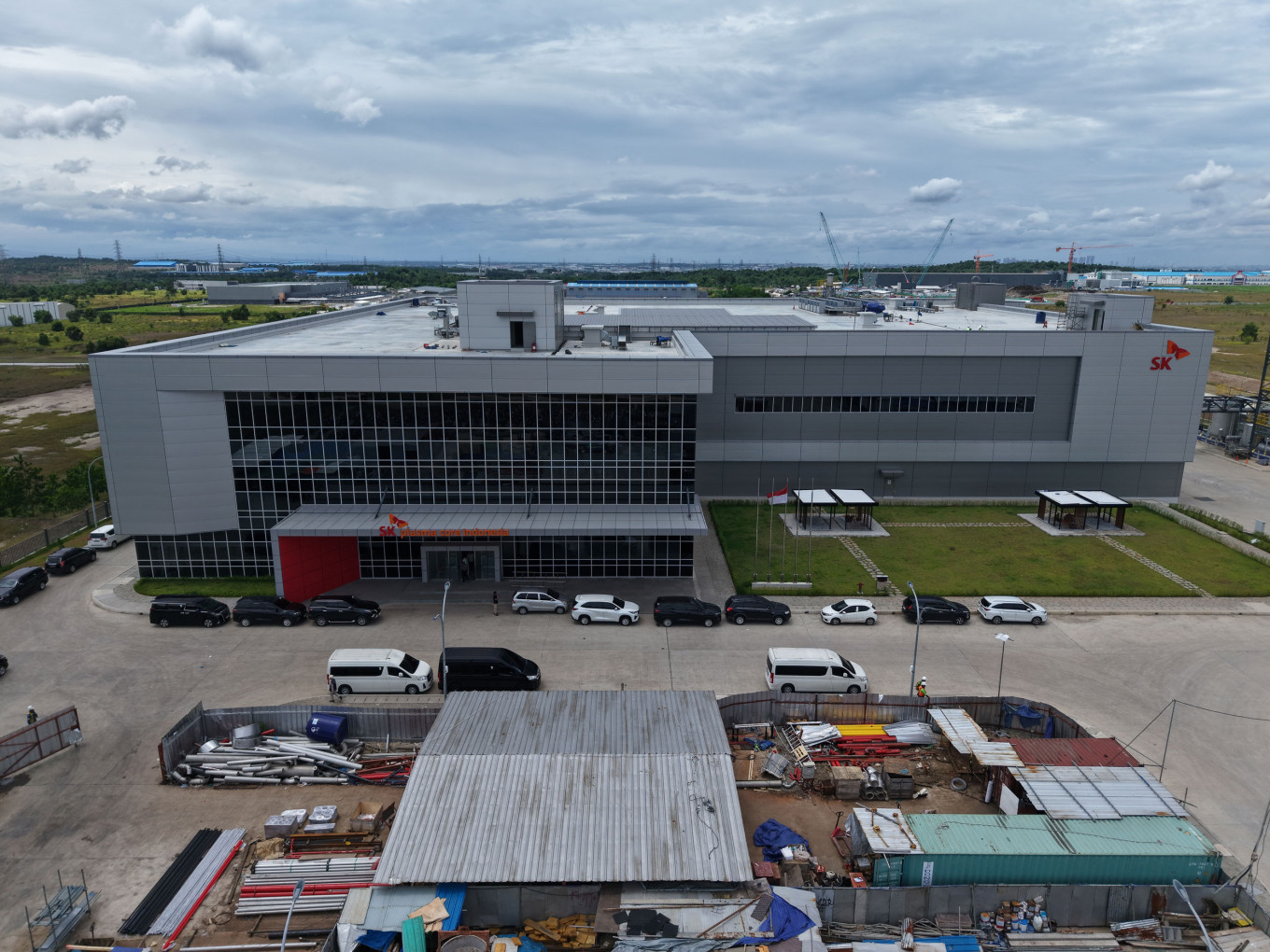
ndonesia is set to host its first-ever plasma fractionation plant in Karawang, West Java, which is poised to become the largest such facility in Southeast Asia. This milestone marks a major step toward operational readiness, strengthening national healthcare resilience.
Construction of the SK Plasma Fractionation Plant is 98.72 percent complete and is expected to be finalized, with operations beginning, in February 2026. The long-awaited facility, which has an annual production capacity of 600,000 liters of plasma, is scheduled to commence full-scale production in 2026.
Owned by PT SK Plasma Core Indonesia, a joint venture between South Korea’s SK Plasma and the Indonesia Investment Authority (INA), the 4.9-hectare plant was developed following a ministerial decree issued in December 2023 appointing the company as Indonesia’s official plasma fractionator.
INA CEO Ridha DM Wirakusumah expressed enthusiasm for the establishment of the plasma fractionation plant, noting that Indonesia had aspired to own such a facility for the past 17 years. The ambition was realized in 2023, when SK Plasma and the INA, with government support, agreed to jointly develop the project.
Indonesia, through the Indonesian Red Cross (PMI), collects approximately 4 million blood bags annually. “Only the erythrocytes are used, while the plasma and white blood cells [leukocytes] are discarded,” Ridha said.
Plasma is a vital component of health security. Currently, Indonesia relies entirely on imports to meet domestic demand for plasma-derived medicinal products (PDMPs). “Therefore, it is timely for Indonesia, as the world’s fourth-most populous country, to have a plasma fractionation plant,” he added.

“Most importantly, the plant will strengthen our health security and sovereignty. We collect blood from our own people, process it domestically to meet national needs, and export the remaining products,” Ridha said.
SK Plasma president director Ted Roh said one of Indonesia’s biggest challenges is its total dependence on imported plasma-derived medicinal products. He recalled that during the COVID-19 pandemic, Indonesia struggled to secure these essential medicines as many countries imposed export restrictions.
He also noted that some doctors and medical institutions remain unfamiliar with the benefits of plasma-derived medicinal products. “These products are designated as essential medicines by the World Health Organization [WHO]. They cannot be replaced by other medicines, which makes them critical to healthcare security in Indonesia,” Roh told journalists during a media visit to the Karawang plant on Dec. 18.
Another issue, he said, is that around 200,000 liters of plasma collected annually from donors are discarded. Meanwhile, Indonesia, with a population of 280 million, has strong potential in plasma-derived medicinal products
“That is why we started this business together with the Indonesian government and INA,” he said. “The collaboration between SK Plasma and INA has enabled the implementation of the plasma fractionation plant project in Karawang,” Roh added.
SK Plasma, a subsidiary of SK Group, South Korea’s second-largest conglomerate, operates a state-of-the-art GMP-certified manufacturing facility in Andong. The company has expanded its global footprint to more than 20 countries, exporting plasma-derived medicinal products and offering toll manufacturing and technology transfer services.
According to Roh, creating value from previously discarded plasma motivated SK Plasma, as a foreign investor, to develop the Indonesian project in collaboration with the INA, an initiative of strategic importance for the Indonesian government. “Through this project, we are not only utilizing plasma that was previously discarded, but also producing essential medicines to protect people’s lives,” he said.
Roh outlined a two-phase approach: toll manufacturing and technology transfer, followed by domestic manufacturing to achieve self-sufficiency in plasma-derived medicinal products.
While construction is being finalized, plasma collected in Indonesia has been sent to South Korea for processing into finished products, including SK GammaBio and SK Albumin. SK GammaBio, a human immunoglobulin G (IVIG) product, is used to treat immunodeficiency and autoimmune diseases. SK Albumin is a protein solution administered intravenously to patients with conditions such as severe burns, liver disease or hemorrhagic shock.
These products were jointly launched by SK Plasma Core Indonesia and the Health Ministry in conjunction with National Health Day on Dec. 8.
“I believe this manufacturing initiative will replace imported products with locally produced medicines made from Indonesian plasma,” Roh said.
During the construction phase, SK Plasma sent its first batch of 15 Indonesian employees to its fractionation plant in Andong for training. The July–December 2025 program focused on qualification and skills development. The second and third batches are scheduled for engine-running training in June 2026 and commercialization training in 2027.
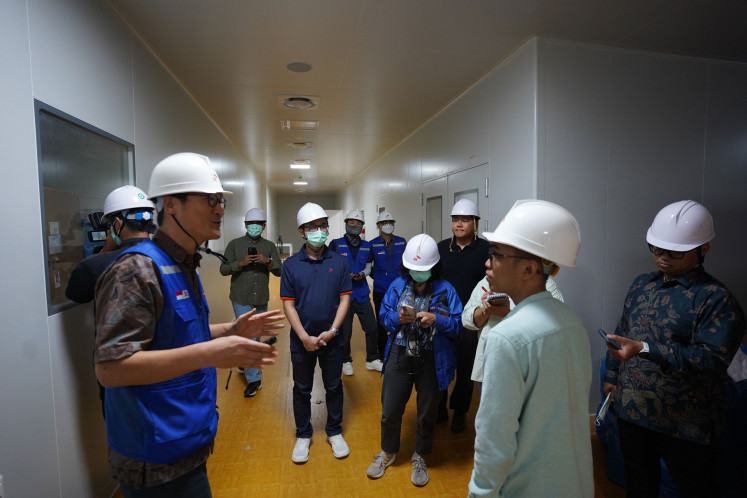
“These employees have just returned to Indonesia and started working today. This is very meaningful for us, as they bring back the training, expertise and technology needed to operate the factory,” Roh said.
The plant is expected to employ around 300 people. “Training programs will be conducted both off-site and on-site, and technology transfer will be carried out in phases,” he added.
The plasma fractionation plant aligns with the government’s healthcare priorities by supporting national self-reliance in critical medicines, including albumin and immunoglobulin. It is also expected to reduce dependence on imported blood medicines and strengthen Indonesia’s pharmaceutical and biopharmaceutical industries, in line with the National Medium-Term Development Plan (RPJMN).
As one of the largest plasma fractionation plants in Southeast Asia, the facility has an annual capacity of 600,000 liters of plasma, which can be expanded to 1 million liters per year, according to Roh.
On average, each donor contributes about 200 milliliters of plasma. To operate at full capacity, the plant requires around 3 million donors annually, a target Roh believes is achievable given Indonesia’s large population.
With domestic production, products from the Karawang plant are expected to be priced 8 to 10 percent lower than imported alternatives.
Global Standards
According to Roh, the company will focus next year on qualification, validation and GMP inspections. “We need to improve our level of qualification to meet global standards,” he said.
With an expected surplus of plasma-derived medicinal products for export, the plant must comply with international standards. “Each country’s regulatory authority must inspect our facility and procedures. That is why we continuously improve quality, processes and standard operating procedures to meet advanced global standards,” Roh said.
INA Vice President of Investment Andre J. Cahyadi said health care is one of the INA’s priority investment sectors. “Our mission is to invest in sectors that benefit future generations while increasing foreign direct investment [FDI]. This project not only brings FDI to Indonesia but also strengthens national healthcare security,” he said.
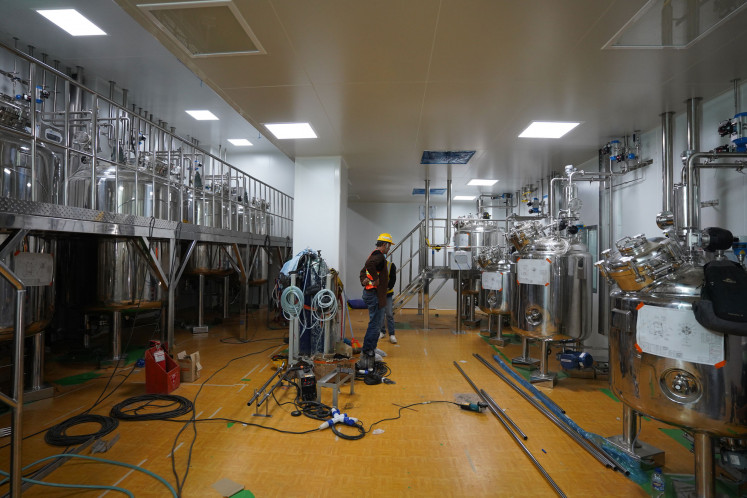
During the media visit, the plant showcased cutting-edge technology used to produce plasma-derived medicinal products such as albumin and immunoglobulin. The facility employs an integrated system of tanks and vessels, beginning with plasma fractionation to extract proteins, followed by purification through chromatography. Virus inactivation and removal are ensured through multiple processes, including nanofiltration, according to plant staff.
As the SK Plasma fractionation plant nears full completion, Indonesia is moving closer to achieving self-sufficiency in plasma-derived medicines. With advanced capabilities, adherence to international standards and a strong knowledge-transfer ecosystem, the facility is expected to build a more resilient healthcare system, reducing import dependence and positioning Indonesia as a regional leader in plasma fractionation.