TheJakartaPost
Please Update your browser
Your browser is out of date, and may not be compatible with our website. A list of the most popular web browsers can be found below.
Just click on the icons to get to the download page.


Popular Reads
Top Results
No results found. Please check your search term and try again
Can't find what you're looking for?
View all search results
Popular Reads
Top Results
No results found. Please check your search term and try again
Can't find what you're looking for?
View all search resultsIndosat just posted a strong performance. Is the company’s AI bet paying off?
Change text size
Gift Premium Articles
to Anyone
Share the best of The Jakarta Post with friends, family, or colleagues. As a subscriber, you can gift 3 to 5 articles each month that anyone can read—no subscription needed!
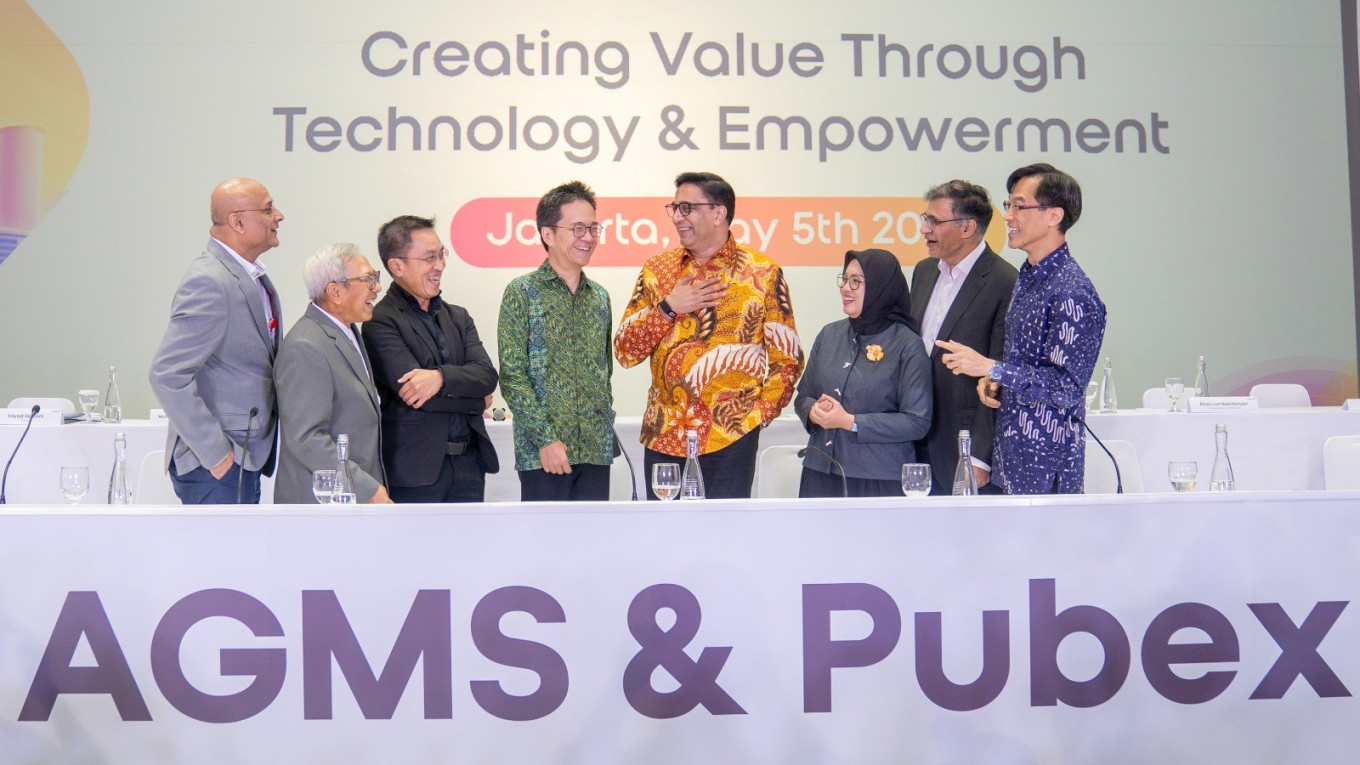 One of Indonesia’s largest telecom companies just posted one of its best quarterly performances. The real test is whether it can own the AI infrastructure layer of a $130 billion digital economy. (Courtesy of Indosat Ooredoo Hutchison)
I
ndosat Ooredoo Hutchison has consistently shown consistent momentum and numbers, recording steady year-on-year growth over the past three consecutive quarters.
In the first quarter of 2026, Indosat recorded total revenue of Rp 15.2 trillion, growth of 12 percent year-on-year. Earnings before interest, taxes, depreciation and amortization (EBITDA) expanded 13 percent to Rp 7.2 trillion with a margin of 47.6 percent, while net profit attributable to shareholders surged by 26 percent.
In addition, combined average revenue per user (ARPU) rose 15 percent year-on-year to Rp 45,000, reflecting the effectiveness of AI hyper-personalization and improvement customers love.
For a company that critics once viewed as a merger aimed at building scale in a highly competitive market, the turnaround has been striking. Beyond the size of the numbers, however, the more consequential story is what is driving them.
The ARPU inflection point
Indosat's monthly ARPU stood at around Rp 39,000 through the first half of 2025, before gradually increasing to Rp 40,000 in Q3 and accelerating further to Rp 44,000 in Q4. The inflection came with the rollout of AI-enabled services.

That trajectory shift, from a flat line to a 15 percent annual increase, is precisely what Indosat's leadership has been engineering for the past two years, representing the clearest signal yet that the company's "telco to techco" thesis is beginning to show up in unit economics.
"Our progressive ARPU growth is driven by AI-powered hyper-personalization, a stronger network and our relentless focus on delivering a remarkable customer experience," said Vikram Sinha, president director and CEO of Indosat Ooredoo Hutchison.
"Guided by our belief to become ‘Lebih Baik’, we are strengthening our foundation through disciplined investment, operational excellence and AI-driven transformation to build a resilient, inclusive and future-ready digital ecosystem."
The AI-hyper-personalization engine behind that ARPU growth is not a mere marketing concept, but rather intelligence operating across 94 million users, modeling consumption behavior and optimizing offers in real time, at a scale that would be economically impossible without AI.
Data traffic grew 25.1 percent year-on-year, confirming that digital services are increasingly embedded in customers' daily lives. The two figures together, ARPU and traffic growth simultaneously, indicate the company is generating more value from each user while deepening engagement, a combination that typically precedes sustained margin expansion.
From connectivity to compute: a business model shift
What distinguishes Indosat's current trajectory from conventional telco improvement is the emergence of an entirely new revenue stream: selling AI infrastructure to enterprises and the government.
The AI Neocloud business, powered by NVIDIA infrastructure, generated US$16 million in revenue during Q1 2026 alone, with approximately $170 million in contracted revenues over the next three years, and management has emphasized it is EPS accretive from day one and free-cash-flow positive.
For a company that built its foundation on voice and data plans, the ability to generate this level of contracted enterprise AI revenue this early in the cycle is strategically significant.
This is not accidental. Indosat has spent the past two years assembling infrastructure that most Indonesian enterprises cannot build themselves: a sovereign AI factory built with NVIDIA, a cloud security layer with Cisco, an AI Center of Excellence with the Communication and Digital Affairs Ministry, and most recently a partnership with Google that bundles Gemini access into mobile data plans.
Sinha has been explicit about the commercial logic: "There has to be a right balance between the short term, midterm and long term. The most challenging thing is making sure that we are very clear on how it is helping us on our P&L."
That clarity is increasingly reflected in the balance sheet. Net debt fell 9.2 percent year-on-year to Rp 8.5 trillion, with the net debt-to-EBITDA ratio improving to 0.31 times, even as capital expenditure surged 59.6 percent year-on-year. Indosat is simultaneously investing more and becoming less leveraged, a combination that typically signals strong operating cash generation.
The infrastructure advantage nobody is talking about
Beyond the financial results lies a structural position that has implications well beyond Indosat's own shareholders.
Indosat completed Southeast Asia's first AI-RAN powered Layer 3 5G call using an open, cloud-native network with Nokia AirScale remote radio heads and NVIDIA GPU acceleration, demonstrating simultaneous AI and network workloads on shared infrastructure in a live operator setting.
The achievement placed Indosat alongside T-Mobile US and SoftBank as one of a handful of global operators at the frontier of AI-native radio networks, a technology that would allow the wireless network itself to become a distributed computing platform, monetizable for edge AI workloads beyond traditional connectivity.
The AI-RAN Research Center in Surabaya, Asia's first Nokia-NVIDIA collaboration site of its kind is the physical manifestation of that strategy. Sinha describes the ambition plainly: "When connectivity meets compute, it creates intelligence, delivered at the edge, in a sovereign manner. This is how AI unlocks real impact, from personalized tutors for children in rural areas to precision farming powered by drones."
The macro backdrop gives that vision a concrete scale. According to a joint study by Google, Temasek and Bain & Company, Indonesia's digital economy is estimated to have exceeded $130 billion in 2025.
Indosat's own research, produced with Twimbit, projects that sovereign AI could contribute up to $140 billion to Indonesia's GDP by 2030, driving annual economic growth of up to 6.8 percent. If that projection has even partial validity, the operator sitting at the intersection of nationwide connectivity infrastructure and AI compute infrastructure occupies a uniquely strategic position.
The risk in the ambition
None of this is without execution risk, and Sinha himself acknowledges the tension between speed and sustainability: "What is very important is not to get into a tactical use case approach. If your foundation model of data is not done properly, if your design is not reusable, and if these things are not structured properly, you will not scale up.”
But Indosat’s Q1 2026 results suggest the company has cleared at least the first hurdle: demonstrating that AI investment can generate returns within a reasonable time horizon, rather than requiring indefinite patience from investors.
For Indonesia, a country that has long imported its technology infrastructure rather than building it, the more important question may be whether Indosat's ambition to be the backbone of the nation's AI economy succeeds. The answer will shape not just one company's valuation, but where the archipelago sits in the global digital order over the next decade.
"We do not want Indonesia to be only a consumption market. We want to build infrastructure as well,” Sinha concluded.