TheJakartaPost
Please Update your browser
Your browser is out of date, and may not be compatible with our website. A list of the most popular web browsers can be found below.
Just click on the icons to get to the download page.


Popular Reads
Top Results
No results found. Please check your search term and try again
Can't find what you're looking for?
View all search results
Popular Reads
Top Results
No results found. Please check your search term and try again
Can't find what you're looking for?
View all search resultsFinding the best alternative to LPG
In 2025, the subsidized three‑kilogram green cylinder retail price was Rp 16,000, against an estimated market price of around Rp 48,000, with the state covering the full gap.
Change text size
Gift Premium Articles
to Anyone
Share the best of The Jakarta Post with friends, family, or colleagues. As a subscriber, you can gift 3 to 5 articles each month that anyone can read—no subscription needed!
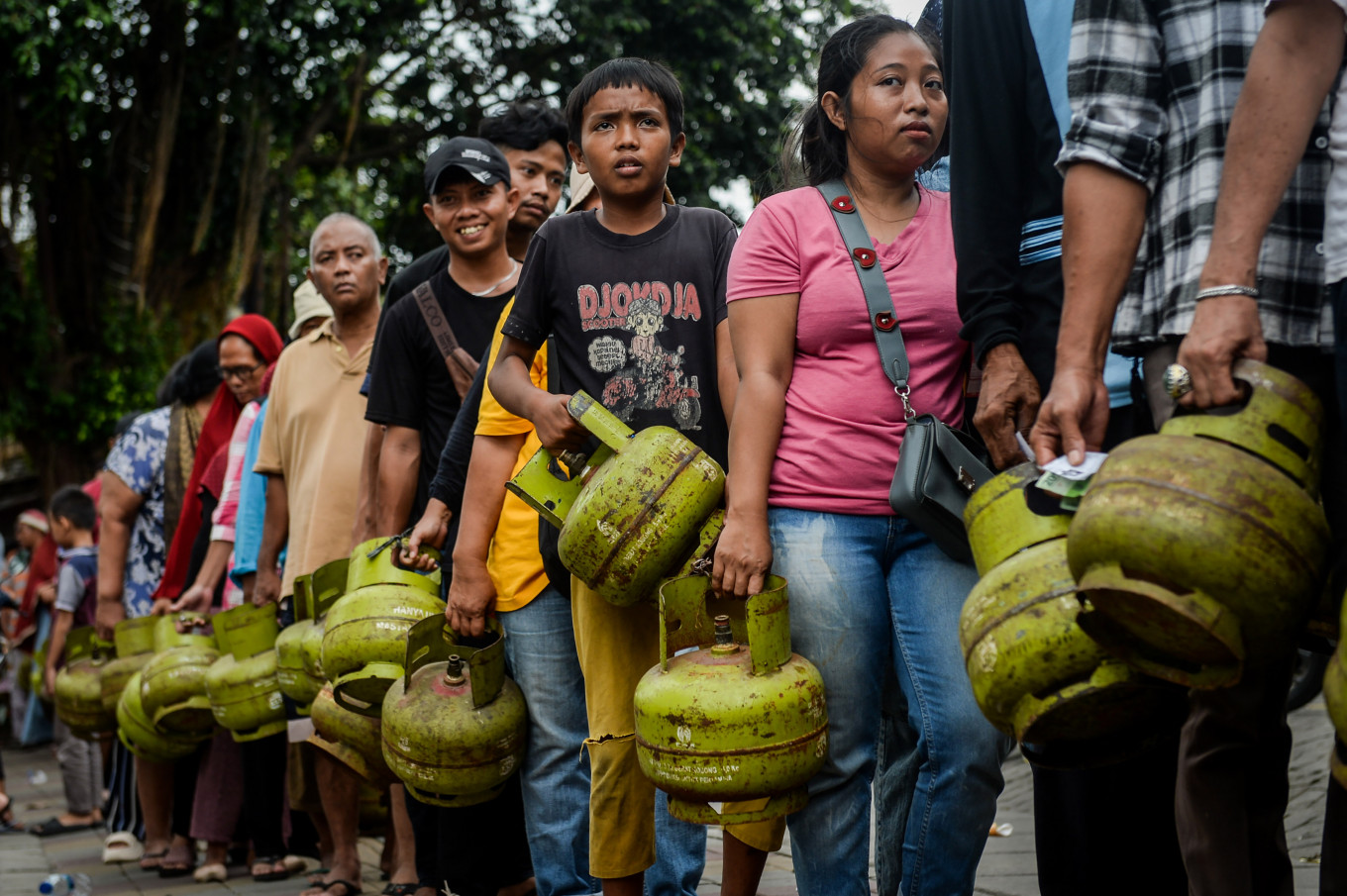 Residents line up to exchange 3-kilogram liquefied petroleum gas (LPG) canisters in Cibodas, Tangerang city, Banten on Feb. 3, 2025. (Antara Foto/Putra M. Akbar)
E
very morning, roughly 74 million Indonesian households follow the same ritual: lighting a stove. Around 90 percent of them, or about 66 million households, rely on liquefied petroleum gas (LPG) as their primary cooking fuel, with most using the subsidized bright green 3-kilogram cylinder.
What few realize is that they only pay a third of the true cost. The government quietly absorbs the rest, to the tune of over Rp 80 trillion (US$4.5 billion) a year. In 2025, the subsidized three‑kilogram green cylinder retail price of Rp 16,000, against an estimated market price of around Rp 48,000, with the state covering the full gap.
Ironically, Indonesia is a net exporter of natural gas, yet most of the LPG that households burn every day still has to be imported. In 2025, Indonesia imported about three‑fourths of its demand, roughly 7.5 million tons of LPG valued at $3.8 billion.
As of April 2026, the estimated market price of the three‑kilogram green cylinder rose to around Rp 57,000 due to United State-Israeli war with Iran pushing energy prices higher, while the subsidized retail price was maintained at Rp 16,000. If the government maintains the LPG three‑kilogram quota at 8.2 million tons, the subsidy burden could rise by 39 percent to Rp 117.7 trillion from Rp 80.3 trillion in this year’s state budget.
Yet Indonesia is not without alternatives. Compressed natural gas (CNG) and household gas network (Jargas) both draw on domestic gas reserves, while the induction stove runs on electricity from the country's abundant coal.
The government is actively exploring a large-scale CNG transition for household cooking, framing it as a natural fit given Indonesia's abundant domestic gas reserves. But is CNG truly the right long‑term solution for household cooking fuel?

CNG has genuine strengths. Indonesia is one of the world’s top natural gas producers, so the energy source is domestically available and not subject to import‑price swings. A three‑kilogram CNG cylinder costs around Rp 47,500, equivalent to roughly Rp 2,202 per kilowatt-hour (kWh), making it about 17 percent cheaper than non‑subsidized LPG. Existing LPG stoves also require no modification.
The physics, however, imposes hard constraints. CNG must be stored at 200 to 250 bars, up to 20 times LPG's storage pressure and requires 2.5 times more volume to deliver the same energy. The government's Type 4 carbon-fiber composite cylinder addresses the weight problem and is reported to be lighter than a standard LPG 3 kg cylinder, but Indonesian National Oil and Gas Companies Association (Aspermigas) confirmed that it currently costs 10 to 20 times more than a standard LPG cylinder. This makes CNG remain best suited for fleet vehicles and commercial kitchens, not yet households.
Jargas bypasses the cylinder problem. At roughly Rp 1,807 per kWh, it draws on the domestic gas network with no import exposure. However, the fundamental barrier remains last-mile economics, connecting each household requires dedicated pipework, civil excavation and metering, costs only recoverable in dense urban corridors. For the dispersed settlements and rural communities where most LPG users live, Jargas is not a realistic near-term option.
Both options, however, face a deeper structural constraint. Domestic natural gas production is in long-term decline while consumption continues to rise, leaving shrinking headroom for household allocation.
The induction stove, by contrast, offers the lowest running cost of any alternative, at roughly Rp 1,498 per kWh. Electricity already reaches almost the entire country, with the national electrification rate at 99.8 percent by 2025. Moreover, a large-scale induction rollout would help absorb Indonesia's electricity surplus, backed by the abundant coal that remains the country's primary source of generation.
State-owned electricity company PLN could reintroduce induction stoves through a dedicated miniature circuit breaker (MCB) circuit. The company can upgrade a household's main MCB and add a dedicated ring-fenced cooking circuit of 1,200 to 2,000 watts for the induction stove only, with installation costs, stoves and compatible cookware covered under the program.
Under this arrangement, 450-VA and 900-VA households gain sufficient capacity without changing their tariff class or paying upgrade fees. Since the cooking circuit is ring-fenced, the government can directly provide, track, and control the cooking subsidy in a way the cylinder system has never allowed.
The government first attempted a national induction rollout in 2022, but the House of Representatives rejected the plan in September that year. The central objection was structural, as existing 450-VA and 900-VA connections were incompatible with induction stoves, and the capacity upgrade cost would fall on households least able to bear it. Recipients also faced additional upfront investment in new stoves and induction-compatible cookware.
Despite the political setback, the induction stove makes the strongest long-term fiscal case. The state currently spends Rp 1,901 per kWh subsidizing LPG cooking, against Rp 757 per kWh for induction, more than halving the subsidy burden. To put that in perspective, at the subsidized price, LPG costs consumers the equivalent of roughly Rp 742 per kWh. At the market price, that rises to around Rp 2,643 per kWh.
The transition away from the green cylinder does not need to converge on a single replacement technology. A more resilient approach keeps all four pathways open and directs each to where it fits best.
Induction for the households with adequate grid connections. Jargas for dense urban corridors already served by the expanding pipeline network. CNG for commercial kitchens, hotels and fleet vehicles able to handle high-pressure storage. And LPG, with subsidy better targeted to those who genuinely need it, for rural and remote communities where none of the three alternatives are yet viable.
A deliberate, segmented shift, with each technology carrying the users it is best suited to serve, is the approach most likely to work.
*****
The writer is an industry and regional analyst at Bank Mandiri.