TheJakartaPost
Please Update your browser
Your browser is out of date, and may not be compatible with our website. A list of the most popular web browsers can be found below.
Just click on the icons to get to the download page.


Popular Reads
Top Results
No results found. Please check your search term and try again
Can't find what you're looking for?
View all search results
Popular Reads
Top Results
No results found. Please check your search term and try again
Can't find what you're looking for?
View all search resultsEurope's baked rice bowl seeks escape from drought
Pavia is at the heart of Italy's rice-making industry. The province regularly produces nearly 5 million tonnes of the grain each year. But this year there was not enough spring rain and its rice farmers are despondent.
Change text size
Gift Premium Articles
to Anyone
Share the best of The Jakarta Post with friends, family, or colleagues. As a subscriber, you can gift 3 to 5 articles each month that anyone can read—no subscription needed!
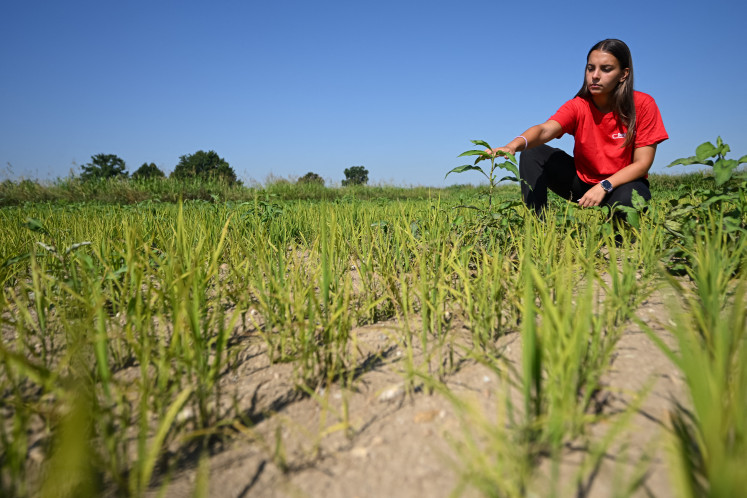
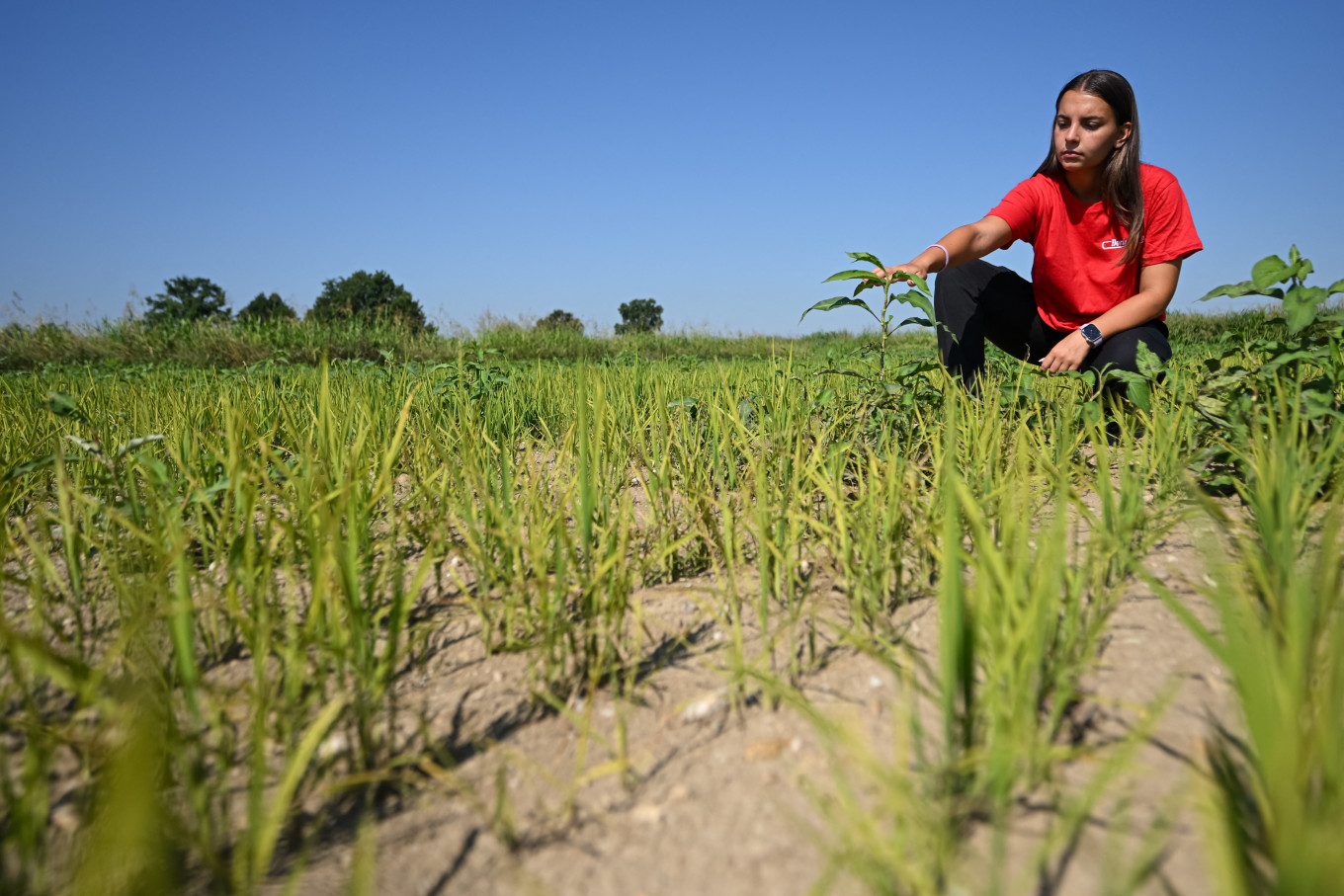 Farmer Sharon Angoli, 22, inspects rice plants struggling to grow in a paddy field overrun by weeds during a drought in Torre Beretti, near Pavia, on July 3, 2026. (AFP/Piero Cruciatti )
S
ummer came too early to Europe's most important rice growing region and weeds are taking over Sharon Angoli's parched paddies in Italy's Pavia province.
"That one is done for, no matter what happens," the 22-year-old said as she surveyed one desolate field that has been baked by what is among the most severe heatwaves to hit the continent in June.
Even abundant rains for the rest of the summer would probably not save the crop, she said. Angoli and her father, Carlo, also fear for their other fields at Torre Beretti, about 60 kilometers south of Milan, that should be harvested in September.
"We need about 50 millimeters of rain, but without hail," said Carlo Angoli. "Or a big hailstorm in September and then the insurance will reimburse us," he joked.
Pavia is at the heart of Italy's rice-making industry. The province regularly produces nearly 5 million tonnes of the grain each year.
But this year there was not enough spring rain and its rice farmers are despondent.
Rivers on life support

From the Alps to the Adriatic Sea, several waterways in northern Italy are in a "critical situation" because of drought, the Po River Authority (ADBPO) warned on Friday.
Lakes are being drained to feed the Po and its tributaries, but at the current rate, the reserves will run out within weeks.
The province at the foot of the Apennine mountains is used to abundant rain. The rice fields are normally lush green this time of year.
But with temperatures now rising above 30C, Sharon Angoli has had to restrict irrigation and like other farmers fears a repeat of a devastating drought in 2022.
One of the fields used to produce rice for sushi has not been flooded and the weeds are the biggest beneficiaries.
Some rain has brought down temperatures in recent days, but they are predicted to rise again for the next two weeks to levels that Carlo Angoli said were "ideal for going to the beach".
"In a normal season, there would be water everywhere," said Nicola Valdi, 55, a neighbor of the Angolis. She told how it protects the rice in what is a "critical phase" of its growth and must not absorb too much toxic cadmium.
"A healthy plant would have 70 to 80 grains. This one will produce 10," she said, pointing to one shrivelled shoot.
Water rivals
The water shortage has left angry fallout.
Farmers in the Lombardy region, which includes Pavia, accuse those in neighboring Piedmont of using too much water. Farmers in the Po delta accuse all their rivals up the Po valley of leaving them with too little.
The heatwave that swept across Europe in June would have been virtually impossible without climate change, according to climatologists from World Weather Attribution.
Italian farmers say the water crisis was foreseeable, however.
Silvia Garavaglia, head of the local branch of the Coldiretti farmers union, said it had been pressing for 20 years to improve the collection of water in winter.
The Legambiente nongovernment group said that agricultural engineering has not kept pace with climate change and that farming needs a new transformation.
Lorenzo Baio, head of water resources for Legambiente Lombardy, said there had to be efforts "to mitigate the summer peak in water demand".
He said the area devoted to corn production had to be cut and water management for rice fields changed so that fields are flooded in spring.
Valdi said she had planted some wheat and soybeans, but they also suffer from the lack of water.
"And they don't pay as well as rice," she added.
Farmers are also "very worried" on the Piedmont side of the valley, near the town of Vercelli, according to Roberto Guerrini, the 55-year-old head of the local Coldiretti branch.
"For now, we've managed to help everyone. We rotate the water among our rice paddies. But if the water doesn't arrive within a week or 10 days, we are going to lose crops," said Guerrini, who produces risotto rice.