TheJakartaPost
Please Update your browser
Your browser is out of date, and may not be compatible with our website. A list of the most popular web browsers can be found below.
Just click on the icons to get to the download page.


Popular Reads
Top Results
No results found. Please check your search term and try again
Can't find what you're looking for?
View all search results
Popular Reads
Top Results
No results found. Please check your search term and try again
Can't find what you're looking for?
View all search resultsRegaining retail investors’ confidence
In the first and second weeks of July, average daily transactions reached only Rp 10 trillion to Rp 11 trillion, down sharply from more than Rp 22 trillion in June 2026.
Change text size
Gift Premium Articles
to Anyone
Share the best of The Jakarta Post with friends, family, or colleagues. As a subscriber, you can gift 3 to 5 articles each month that anyone can read—no subscription needed!
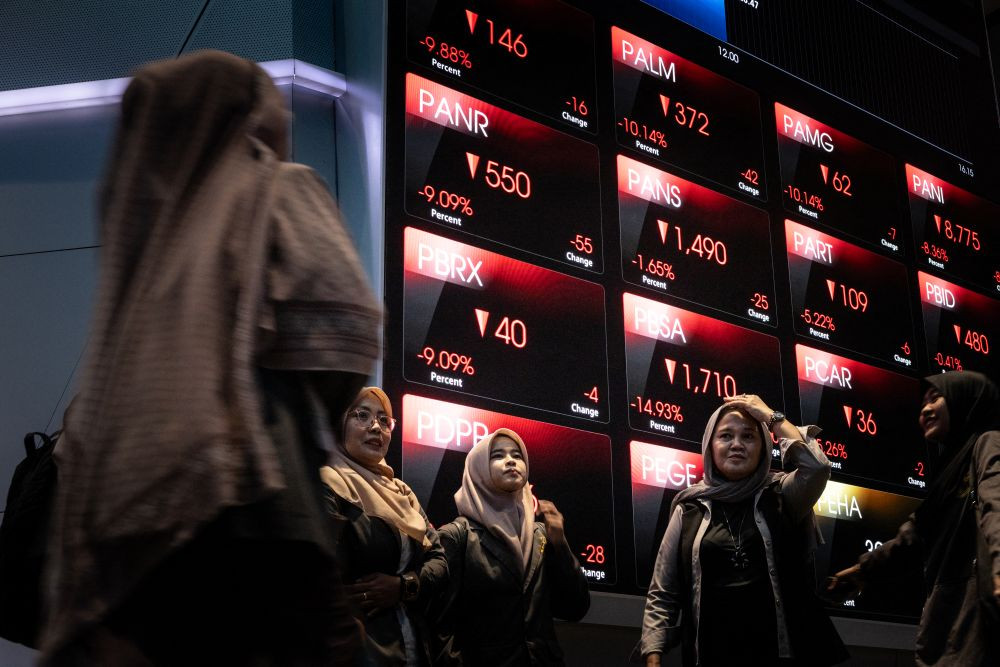 Momentous shot: A group of visitors takes a picture on Jan. 29, 2026, in front of a stock ticker display at the Indonesia Stock Exchange (IDX) in South Jakarta. (AFP/Yasuyoshi Chiba)
W
hile modern trading strategies, artificial intelligence and the evolution of technical analysis have emerged, the simple fundamental rule still applies: “buy the dip, sell the rip”. For retail investors, it is easier to digest as buy low and sell high. Whether the rule, in essence, works to make investment gains will depend on the situation.
Over the past decade, a revolution has steadily rewritten the rules of the investing world. Mobile trading apps, lower or even zero commission-trading fees, and the spread of information about investing strategies and recommendations have converted millions of people into retail investors.
For developing countries like Indonesia, this trend could be a game-changer for the capital market, as the flow of foreign investors could significantly affect prices and performance if they pull their cash-out at any moment.
A strong local base of retail investors helps markets discover prices more efficiently by narrowing bid-ask spreads. Retail investors can also act as shock absorbers because they often buy during market downturns. Their strategies are shaped by market psychology, volatility and fear. In periods of uncertainty or weak economic performance, bad news can push stock prices sharply lower, creating opportunities for investors with cash-on-hand to buy undervalued stocks, or “buy the dip.”
Around the world, cultures are responding to this financial shift in different ways. In the United States, Pew Research Centre revealed that stock investing is a common household practice, with families often allocating nearly half of their savings directly to the stock market.
Meanwhile, European households remain more conservative, keeping about a third of their wealth in traditional bank deposits. Direct and indirect stock holding only counted for 27 percent of households’ financial assets.

Vietnam and Indonesia are leading Southeast Asia’s rapid shift toward digital investing. By early 2026, Vietnam had more than 12 million retail investor accounts, representing nearly the entire trading market. To curb excessive speculation, Vietnamese regulators are encouraging investors to move away from high-risk day trading and toward professionally managed mutual funds. Thailand and Malaysia, by contrast, have developed more disciplined systems, with rules designed to keep millions of retail accounts from relying on risky, debt-fueled trading.