TheJakartaPost
Please Update your browser
Your browser is out of date, and may not be compatible with our website. A list of the most popular web browsers can be found below.
Just click on the icons to get to the download page.


Popular Reads
Top Results
No results found. Please check your search term and try again
Can't find what you're looking for?
View all search results
Popular Reads
Top Results
No results found. Please check your search term and try again
Can't find what you're looking for?
View all search resultsIs the Feb. 19 Indonesia–US trade deal fair?
The answer depends on what we mean by “fair”: short-term export survival, balanced reciprocity, or long-term policy autonomy.
Change text size
Gift Premium Articles
to Anyone
Share the best of The Jakarta Post with friends, family, or colleagues. As a subscriber, you can gift 3 to 5 articles each month that anyone can read—no subscription needed!
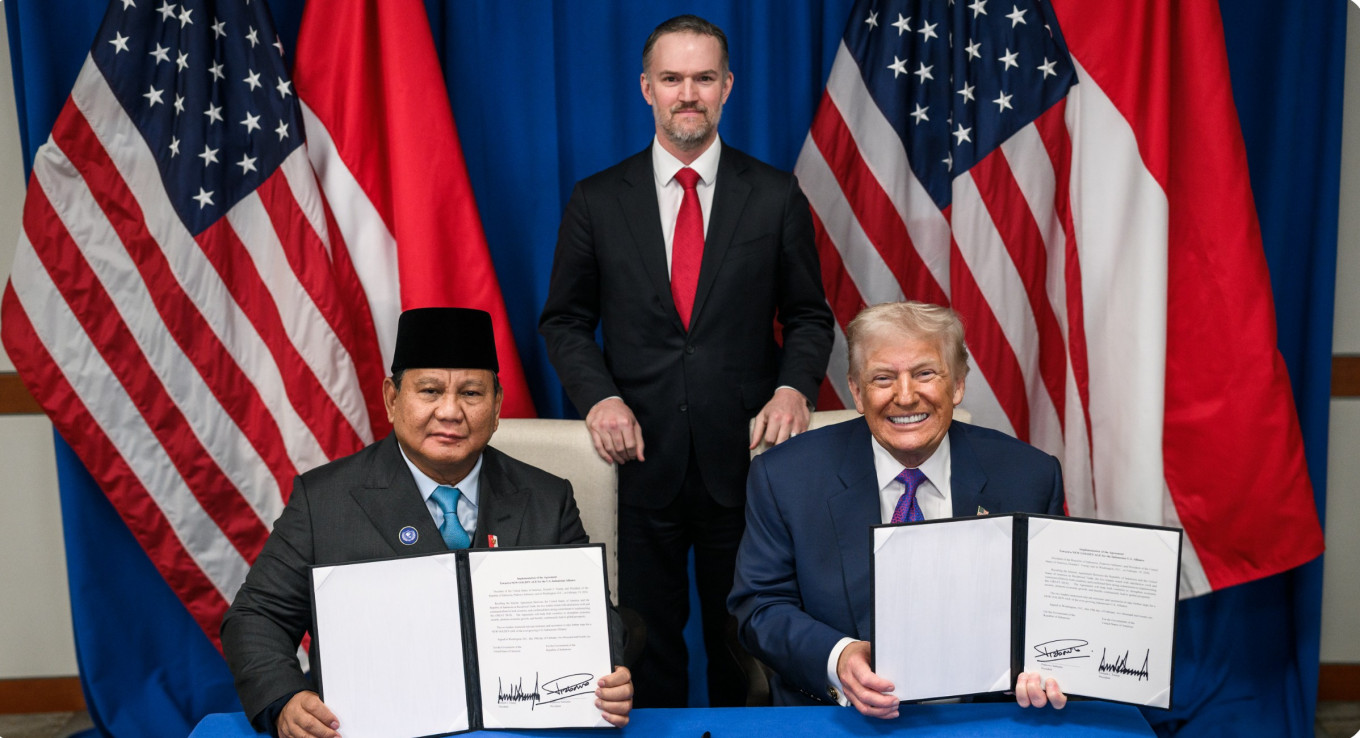 President Prabowo Subianto (left) and United States President Donald Trump (right) show the signed trade deal documents in Washington, DC, on Feb. 19, 2026, as witnessed by US Trade Representative Jamieson Greer. (Office of the United States Trade Representative/-)
O
n Feb. 19, President Prabowo Subianto and United States President Donald Trump signed the Agreement on Reciprocal Trade (ART), concluding months of intense negotiations triggered by Trump’s unilateral imposition of a 32 percent “reciprocal tariff” on Indonesian exports in April 2025. The deal reduces that additional tariff to 19 percent and exempts 1,819 Indonesian products, 1,695 industrial and 124 agricultural, from the extra levy. It also grants tariff-rate quota (TRQ) access for textiles that can reduce tariffs to zero within specified volumes.
The government presents the ART as a necessary diplomatic success: it lowers tariff pressure, protects 4 million to 5 million workers in labor-intensive sectors and secures preferential treatment for key exports such as palm oil, coffee, cocoa, rubber and textiles. Critics, however, worry that Indonesia’s concessions, on tariffs, non-tariff barriers, foreign ownership limits and regulatory alignment, are far-reaching.
So, is it a fair deal? The answer depends on what we mean by “fair”: short-term export survival, balanced reciprocity or long-term policy autonomy.
Indonesia exports roughly US$28 billion to $30 billion worth of goods annually to the US. In 2024, the US recorded a trade deficit with Indonesia of about $19 billion, the figure Washington cited when introducing the reciprocal tariff. A 13-percentage point reduction in the additional tariff as recently agreed, if applied across all exports, would mean a potential relief of several billion dollars per year.
But it is not applied across all exports. According to the government’s FAQ, 1,819 product lines are exempt from the additional reciprocal tariff and will face only the normal US most-favored nation (MFN) tariff. If these exemptions cover the bulk of Indonesia’s major export sectors, as the mention of palm oil, rubber and textile suggests, then perhaps 70 percent or more of Indonesia’s export value may now face only MFN tariffs rather than MFN plus 19 percent.
Under such a scenario, the effective average tariff burden on Indonesian exports might fall to somewhere in the range 9-11 percent, rather than the 13-20 percent range that would prevail if the additional tariff applied broadly. So, the deal likely prevents a significant competitiveness shock.

Yet, fairness cannot be judged solely by tariff arithmetic. It is important to understand that “exempted” products do not enter the US market duty-free unless their MFN tariff is already zero. Apparel and footwear, for example, often face MFN rates in the low-to-mid teens. Avoiding an additional 19 percent is meaningful, but it does not transform market access into open trade.