TheJakartaPost
Please Update your browser
Your browser is out of date, and may not be compatible with our website. A list of the most popular web browsers can be found below.
Just click on the icons to get to the download page.


Popular Reads
Top Results
No results found. Please check your search term and try again
Can't find what you're looking for?
View all search results
Popular Reads
Top Results
No results found. Please check your search term and try again
Can't find what you're looking for?
View all search resultsPublic diplomacy: The hidden cost of war
History repeatedly shows that military success does not necessarily translate into strategic success
Change text size
Gift Premium Articles
to Anyone
Share the best of The Jakarta Post with friends, family, or colleagues. As a subscriber, you can gift 3 to 5 articles each month that anyone can read—no subscription needed!
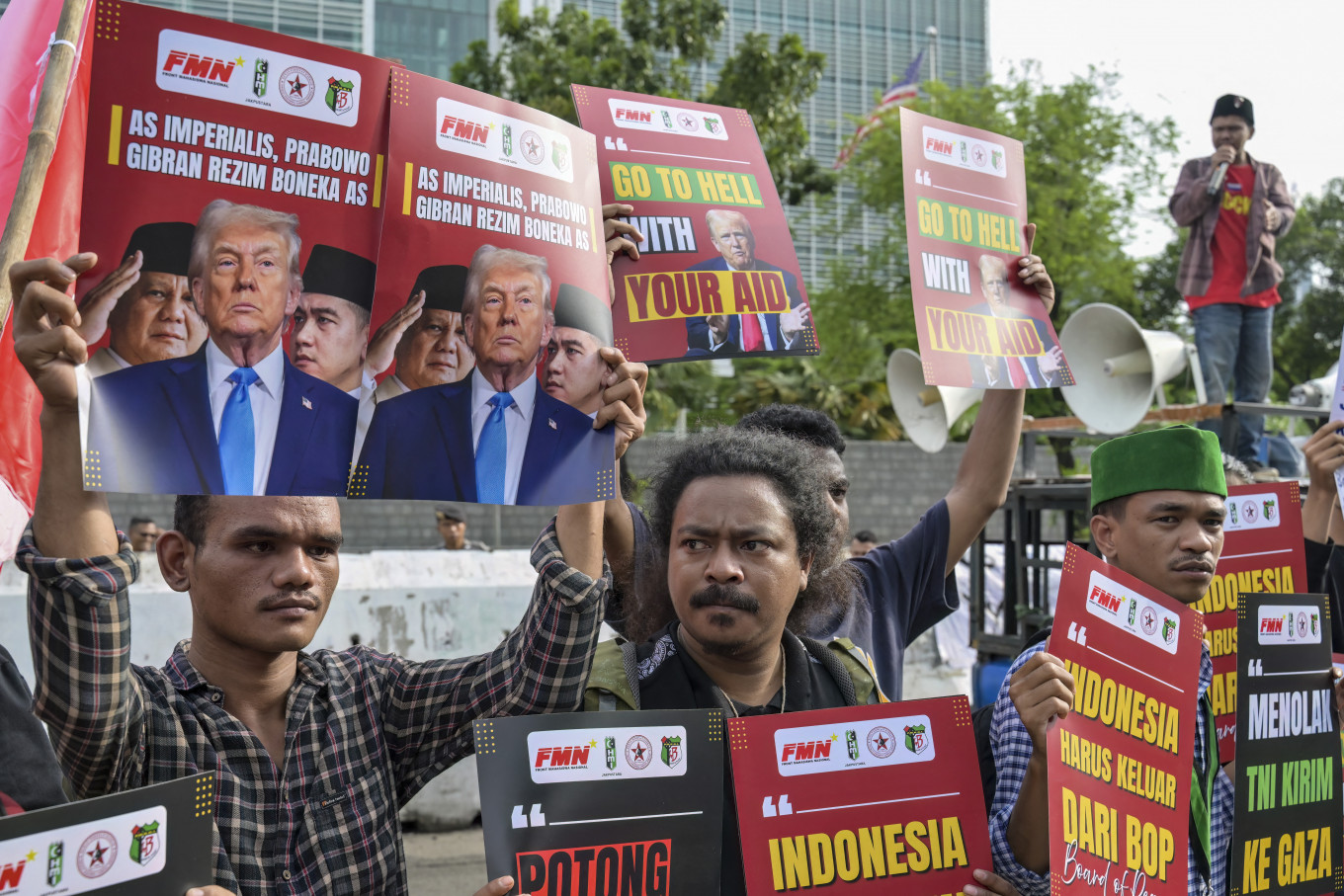 Dozens of protesters hold a rally to condemn United States and Israeli attacks on Iran and Palestinians while holding posters reading 'US Imperialists, President Prabowo Subianto and Vice President Gibran Rakabuming Raka are a US puppet regime' on March 3 in front of the US Embassy in Jakarta. (AFP/Bay Ismoyo)
M
ilitary power often produces a moment of triumph. Precision strikes dominate headlines, targets are destroyed and political leaders present the operation as evidence of resolve and strength. In the short term, such actions can create the appearance of decisive leadership. Yet the longer-term perspective often tells a very different story.
History repeatedly shows that military success does not necessarily translate into strategic success. When a war is launched without plausible cause or clear legitimacy, the most enduring damage is rarely measured on the battlefield. It is measured in the erosion of credibility.
The recent United States and Israeli strike against Iran may appear, at least initially, to represent both political and military success. Iran’s supreme leader, Ayatollah Ali Khamenei, was killed in the bombing, and major military targets, including hundreds of missile launchers and anti-aircraft systems, were destroyed. Iran has since begun attacking US military bases in neighboring countries such as the UAE, Bahrain and Qatar, reflecting the increasingly desperate position of Tehran.
Demonstrating strength has long been a powerful instrument in domestic politics. But international politics unfolds over a much longer timeline. What appears to be a decisive victory in the moment can evolve into a strategic liability in the years that follow. The greatest cost of war often emerges in the realm of public diplomacy, the reputation and trust that sustain international cooperation. History offers several reminders of this dynamic.
The 2003 Iraq War remains one of the clearest examples. In the aftermath of the Sept. 11, 2001, terrorist attacks, the US launched a global campaign against terrorism. When Washington later prepared to invade Iraq, however, much of the international community remained unconvinced. The US argued that Iraq possessed weapons of mass destruction and posed a serious threat to international security. The US-led coalition rapidly removed Saddam Hussein from power, creating the impression of swift military success.
Yet when no such weapons were found, the credibility of the US suffered a profound blow. International opinion surveys recorded a sharp decline in US favorability across many regions of the world, including Europe and the Middle East. In some countries, positive perceptions of the US fell by more than 30 percentage points. The damage to the US' international image has never been fully repaired. Military victory had been achieved, but the damage to trust proved far more enduring.

A similar lesson emerged from the Vietnam War. The conflict demonstrated the limits of military power in achieving political objectives. Despite overwhelming technological and logistical advantages, the US failed to secure the strategic outcome it sought. The war also generated deep domestic divisions and widespread international criticism. Images of the conflict circulated across the world through television and print media, shaping global perceptions of US power in ways that Washington could not easily control.
The consequences extended well beyond the battlefield. The political trauma of the war led to a fundamental reassessment of US foreign policy. The Nixon Doctrine, announced in 1969, reflected the recognition that direct military intervention carried enormous political costs. The US concluded that allies would need to assume greater responsibility for their own defense, while Washington would limit its direct involvement in regional conflicts. In this sense, the Vietnam War reshaped US strategy for decades.
An even earlier episode illustrates how long the shadow of intervention can last. In 1953 the CIA played a key role in the overthrow of Iranian Prime Minister Mohammad Mossadegh. At the time the operation appeared to serve strategic interests, preserving Western influence over Iranian oil and preventing what was perceived as a possible expansion of Soviet influence. Yet the political memory of that intervention proved extraordinarily durable.
In Iran, the coup became a powerful symbol of foreign interference in national sovereignty. The resentment it generated did not disappear with time. Instead, it became a central element in the narrative of the 1979 Iranian Revolution. Even today, the episode continues to shape perceptions of US intentions across the Middle East. What appeared to be a tactical success during the Cold War ultimately created a long-term burden for US diplomacy.
These historical experiences point to a broader lesson. The costs of war unfold across different timelines. In the short term, wars generate military costs measured in lives and materiel. In the medium term, they impose heavy economic burdens and often trigger domestic political backlash.
Prolonged conflicts strain national budgets, deepen social divisions and force political leaders to reconsider strategic commitments. This domestic dimension should not be underestimated.
In recent years, skepticism toward foreign military interventions has grown significantly within the US. Even among supporters of President Donald Trump, opposition to costly overseas wars has become a recurring theme. Their stance reflects a broader sentiment that the US should avoid unnecessary military entanglements abroad. When military action is perceived as unjustified or excessive, the economic and political costs at home can accumulate quickly.
In the long term, however, the most enduring cost appears in the realm of public diplomacy. Reputation cannot be rebuilt as quickly as military capability. Trust is accumulated slowly through consistent behavior and respect for international norms, but it can be lost rapidly when those norms appear to be disregarded. Once credibility erodes, even legitimate policies may face suspicion.
For this reason, decisions about war should never be judged solely by immediate tactical outcomes. Strategic judgment requires consideration of how such actions will shape international perceptions over time.
The experiences of Iraq, Vietnam and Iran all demonstrate that short-term displays of military power can produce long-term diplomatic liabilities. Military force remains a legitimate instrument when a nation must defend itself against aggression.
Yet when force is used without widely recognized legitimacy, the consequences extend far beyond the battlefield. The battlefield may fall silent, but the struggle in public diplomacy often continues long after the war ends.
---
The writer is an adjunct professor at Sogang University. The views expressed are personal.