TheJakartaPost
Please Update your browser
Your browser is out of date, and may not be compatible with our website. A list of the most popular web browsers can be found below.
Just click on the icons to get to the download page.


Popular Reads
Top Results
No results found. Please check your search term and try again
Can't find what you're looking for?
View all search results
Popular Reads
Top Results
No results found. Please check your search term and try again
Can't find what you're looking for?
View all search resultsFacing Section 301, ASEAN must reform systems
What ASEAN must confront is not the tariffs themselves, but the “structure of unfairness determination.”
Change text size
Gift Premium Articles
to Anyone
Share the best of The Jakarta Post with friends, family, or colleagues. As a subscriber, you can gift 3 to 5 articles each month that anyone can read—no subscription needed!
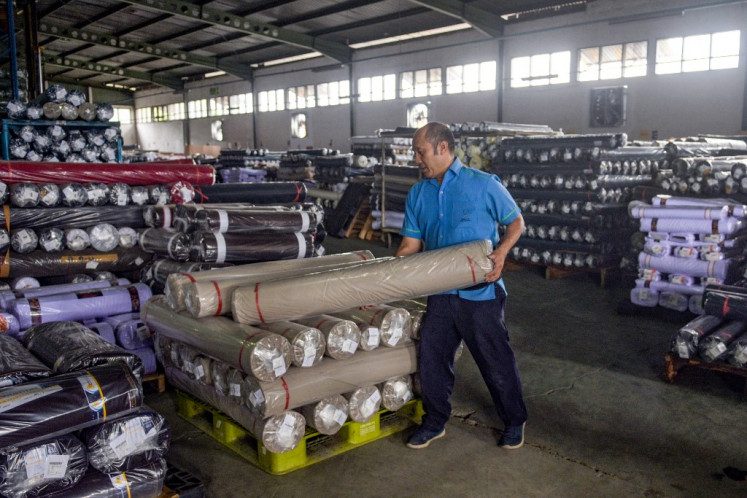
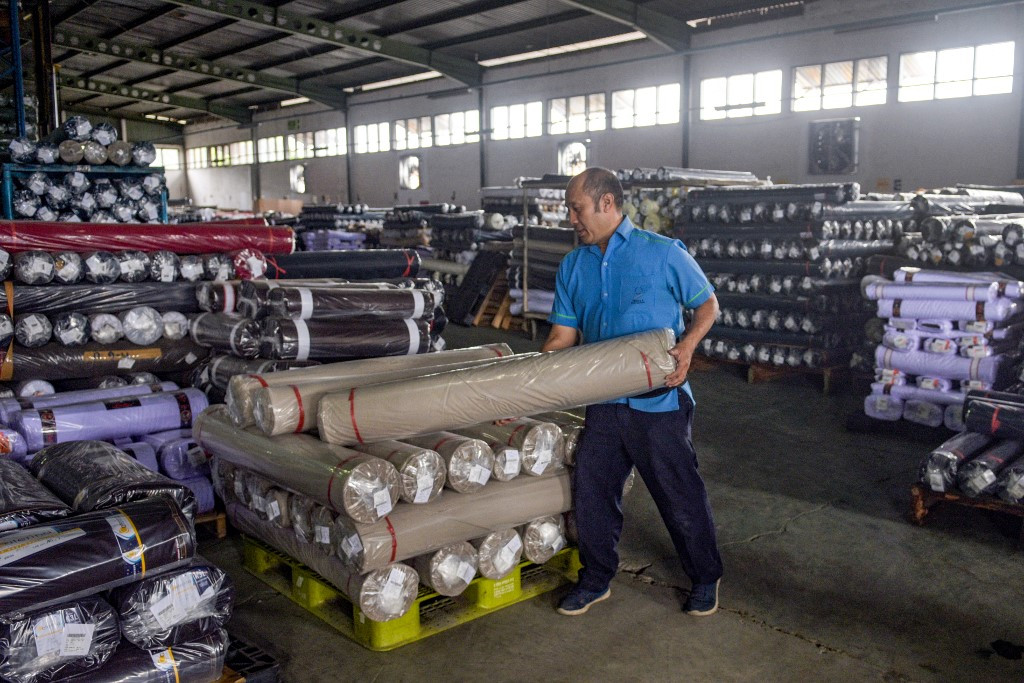 A worker stacks rolls of fabric ready for export on April 15, 2025, at the Trisula Textile Industries factory in Cimahi, West Java. (AFP/Timur Matahari)
T
he United States trade policy is shifting its focus toward more sustainable means of pressure, amid a US Supreme Court ruling that found tariffs imposed under the International Emergency Economic Powers Act (IEEPA) unconstitutional.
Immediately following this unconstitutionality ruling, the Donald Trump administration transitioned to utilizing Section 122 of the Trade Act, which allows for a uniform additional tariff of up to 15 percent.
However, this section is merely a provisional measure (for a maximum of 150 days) based on balance-of-payments grounds.
The US is searching for a “permanent pressure mechanism,” and the primary instrument increasingly regarded as the main vehicle is the broad, cross-sectoral application of Section 301 of the Trade Act.
Rather than just a legal basis for raising tariffs, Section 301 is a policy tool used to deem a partner country’s institutions or practices “unfair” and demand institutional changes.
In other words, the point of contention shifts from tariff rates to the very validity of institutional design.

The essence of Section 301 lies not in the tariff level, but in the structure of which country can be deemed “unfair” and on what grounds.
Therefore, what ASEAN must confront is not the tariffs themselves, but the “structure of unfairness determination.”
A prime example of this is the National Trade Estimate Report on Foreign Trade Barriers (NTE) published annually by the US Trade Representative (USTR).
The NTE is not a mere annual report. It is a collection of points of contention reflecting the awareness of issues within the US, and it can serve as the starting point for future Section 301 investigations.
ASEAN should treat the NTE as an early-warning reference document, organizing counter-arguments by anticipating these points of contention even before the report’s publication.
The core strategy for the Era of Section 301 lies in preemptively eliminating the grounds that could be deemed “unfair.” How can the “material” [that could be deemed unfair] be reduced?
First, it is essential to enhance institutional transparency. What GATT Article X and GATS Article VI require are the publication of laws and regulations, uniform, impartial administration and judicial review.
These disciplines, which may appear abstract, hold extremely strategic significance in today’s context.
Specific transparency measures should be institutionalized, such as setting deadlines for the publication of English versions of laws and regulations, creating a unified database for administrative circulars, and establishing independent review systems for administrative decisions.
By doing so, it becomes harder for the US to point out “arbitrary administration” or “de facto discrimination.”
In this sense, transparency serves as a defensive shield to lower the risk of Section 301 invocation.
Second, it is necessary to enhance the explainability and transparency of subsidy programs and state-owned enterprise (SOE) policies.
In addition to full compliance with WTO subsidy notifications, it is desirable to institutionalize the disclosure of the duration, funding sources, and the number of beneficiary companies for support measures.
Enhancing transparency is not a concession to the US; it is an insurance policy to reduce the risk of future retaliatory measures.
Furthermore, it is necessary to preemptively eliminate US suspicions regarding “trade circumvention” and “false origin declarations.”
While linking customs data within the region and upgrading certificates of origin are necessary, it is crucial to win trust by standardizing supply chain traceability.
Among Japanese companies, demonstration projects for part history management are progressing by combining blockchain and QR codes.
If ASEAN also builds a region-wide common digital origin certification infrastructure, it will be possible to institutionally suppress suspicions of circumvention.
While establishing an infrastructure that leaves no room for doubt weakens the pressure of Section 301, ASEAN must demonstrate such a stance.
It is important to accumulate “institutional assets” that preemptively stifle suspicion, rather than relying on retaliatory tariffs.
In the 2025 tariff negotiations with the US, Vietnam’s agreement triggered other member states to prioritize “avoiding subordination,” leading them to enter into individual negotiations one after another.
As a result, ASEAN was unable to exercise collective bargaining power and achieved only limited results, converging on roughly the same level of tariffs despite making repeated concessions.
This structure closely resembles what is known in game theory as the “Prisoner’s Dilemma.”
Since Section 301 of the Trade Act is also predicated on country-specific invocation, there is a high possibility that similar fragmentation will recur, making collective action as ASEAN structurally difficult.
The fact that ASEAN cannot act with total unanimity is not a weakness in itself. Rather, it should pursue sector-specific early integration through coalitions of willing member states to form a group of “front-running countries” in areas such as subsidy transparency, digital trade, and customs cooperation.
By establishing collaborative frameworks for each point of contention, countries that are ready to act should move first and share their success stories.
ASEAN’s strength lies in its capacity for institutional standardization, cultivated through the process of community building.
As long as Section 301 serves as a pressure mechanism, what counters it is not raw power, but structure.
ASEAN’s objective should be to create an environment where tariffs are difficult to invoke.
The US is searching for points of contention that can be deemed “unfair.”
If so, ASEAN’s strategy must be to “exhaust those points of contention.”
Read the NTE report as a forward-looking indicator, utilize transparency as a defensive asset, and organize institutions through multilayered and sector-specific cooperation. ASEAN’s option in the Era of Section 301 is institutional reform that reduces the very reasons for invoking Section 301.
Neutralizing the justifications for pressure is precisely what constitutes strategic agency.
---
The writer is a professor at the Faculty of Political Science and Economics, Kokushikan University and a visiting professor at Thai-Nichi Institute of Technology, Thailand.