TheJakartaPost
Please Update your browser
Your browser is out of date, and may not be compatible with our website. A list of the most popular web browsers can be found below.
Just click on the icons to get to the download page.


Popular Reads
Top Results
No results found. Please check your search term and try again
Can't find what you're looking for?
View all search results
Popular Reads
Top Results
No results found. Please check your search term and try again
Can't find what you're looking for?
View all search resultsAnalysis: Coal and nickel dilemma: Racing for revenue, lagging in readiness
Change text size
Gift Premium Articles
to Anyone
Share the best of The Jakarta Post with friends, family, or colleagues. As a subscriber, you can gift 3 to 5 articles each month that anyone can read—no subscription needed!
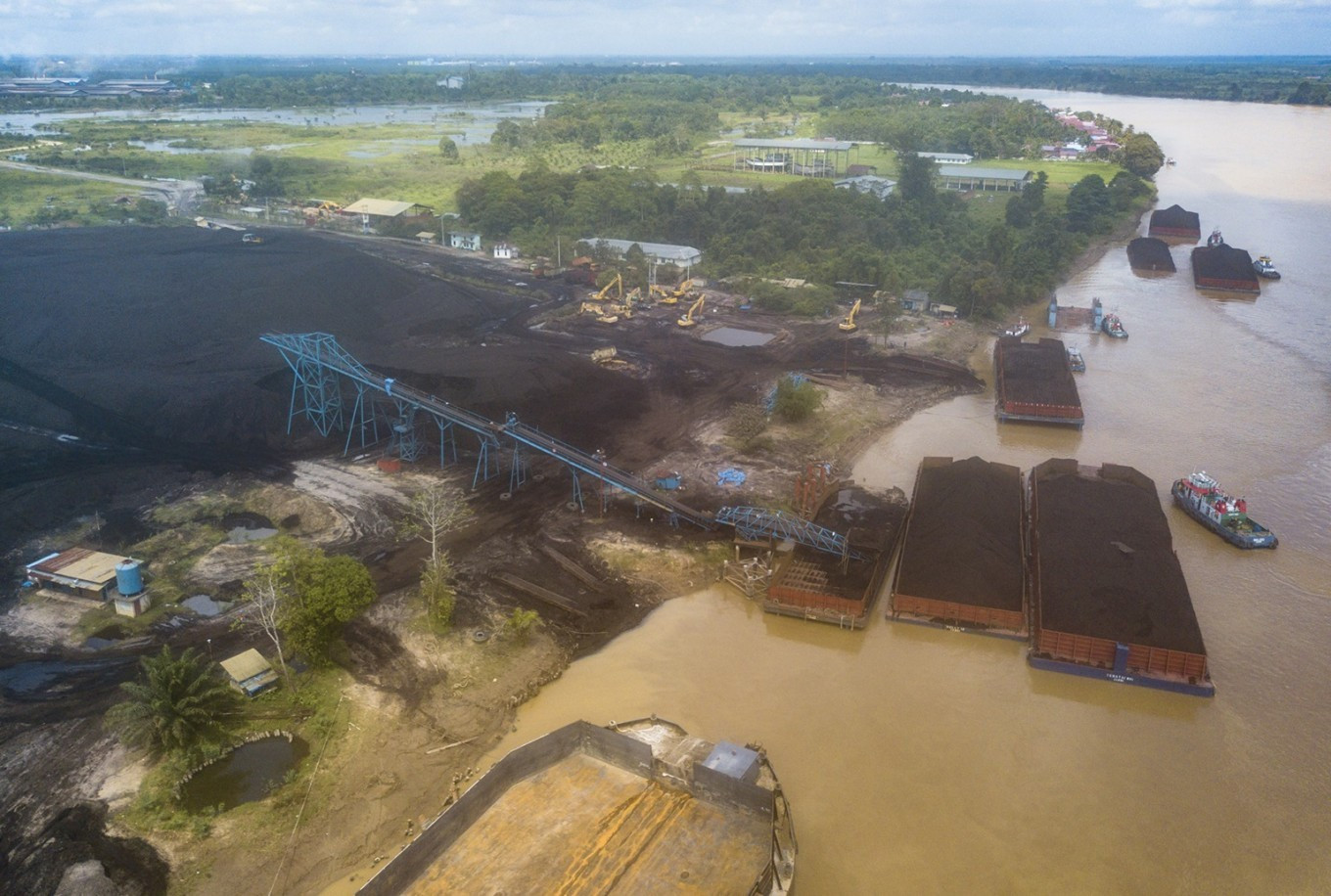 Coal storage barges float in a yard on May 6, 2024, next to the Batanghari River in Muaro Jambi, Jambi. (Antara/Wahdi Septiawan)
A
potentially widening budget deficit amid soaring global oil prices has prompted Finance Minister Purbaya Yudhi Sadewa to explore alternative revenue sources, including export duties on nickel and coal, commodities that are currently benefiting from relatively strong price trends. The push for rapid revenue mobilization, however, appears to be running ahead of sectoral readiness.
President Prabowo Subianto has approved a coal export duty, with tariffs reportedly still under discussion depending on price levels, initially slated for implementation on April 1. However, its rollout remains subject to ongoing cross-ministerial deliberations, particularly regarding its impact on mining sector profitability.
As highlighted by Energy and Mineral Resources Minister Bahlil Lahadalia, the structure of Indonesia’s coal exports complicates policy design. Around 60-70 percent of exports consist of low-calorific, lower-value coal, meaning that a uniform export duty risks disproportionately burdening producers operating on thin margins. This has prompted the minister to adopt a more cautious stance, delaying implementation until a more calibrated approach is formulated.
Yet this caution contrasts with parallel intervention on the supply side. The government has tightened production through the Work Plan and Budget (RKAB) mechanism, capping approved output at around 580 million tonnes. This figure is well below the previous year’s realization of 790 million tonnes, aimed at preventing oversupply and supporting global prices.
The escalation of geopolitical conflict in the Middle East has helped sustain elevated energy and mineral commodity prices. Coal prices have remained consistently above US$135 per tonne, while nickel prices have also stayed relatively stable. This sustained price momentum has prompted the government to take strategic measures to safeguard the state budget. Export duty revenues in the 2026 state budget are projected to surge to Rp 42.56 trillion (US$2.5 billion), marking an increase of more than 850 percent. This sharp rise underscores the urgency behind recent policy initiatives.
This creates a fragmented policy mix. While fiscal authorities push for revenue mobilization through export duties, sectoral regulators simultaneously restrict output to stabilize prices. Rather than a fully coherent strategy, the current approach reflects an unresolved tension between short-term fiscal pressures and longer-term industrial and market considerations. This tension becomes even more apparent when compared with the government’s more assertive stance in the nickel sector.

The government is currently formulating an export duty on nickel-based products, particularly nickel pig iron (NPI), although the exact tariff structure and rates remain under deliberation. At the same time, supply-side controls have been introduced, with the nickel ore RKAB capped at around 150 million tonnes to safeguard domestic availability.