TheJakartaPost
Please Update your browser
Your browser is out of date, and may not be compatible with our website. A list of the most popular web browsers can be found below.
Just click on the icons to get to the download page.


Popular Reads
Top Results
No results found. Please check your search term and try again
Can't find what you're looking for?
View all search results
Popular Reads
Top Results
No results found. Please check your search term and try again
Can't find what you're looking for?
View all search resultsIndonesia has power, it’s time to harness it
Indonesia's energy transition challenge is no longer about resources or policy, but execution.
Change text size
Gift Premium Articles
to Anyone
Share the best of The Jakarta Post with friends, family, or colleagues. As a subscriber, you can gift 3 to 5 articles each month that anyone can read—no subscription needed!
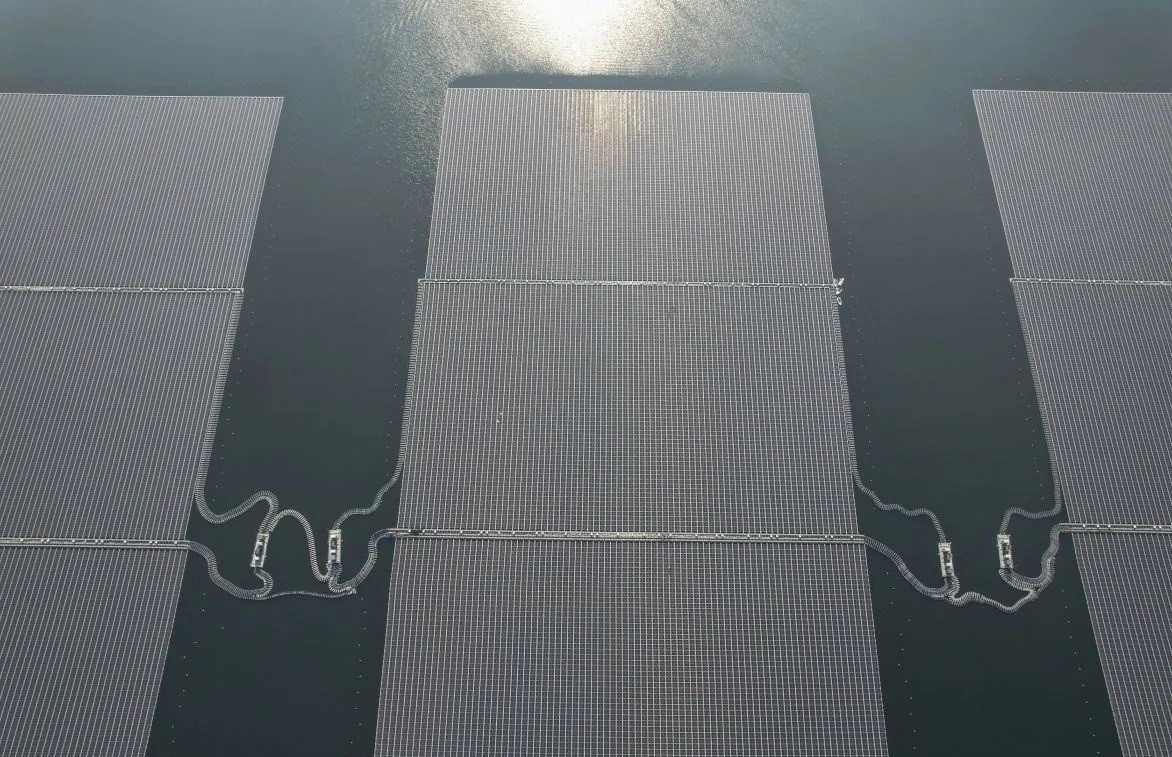 The floating panels of a solar power plant at Cirata Dam in Purwakarta regency, West Java, are seen from above on Sept. 26, 2023. (Antara/Raisan Al Farisi)
I
ndonesia has everything it needs. Vast solar potential. World-class geothermal reserves. A young, technically capable workforce. A government that has set bold renewable energy targets.
By any measure, this country already holds the power to drive one of the most consequential energy transitions in Southeast Asia. And yet, we are falling short.
The national renewable energy mix reached just 15.75 percent in 2025—below the government's own target of 17–19 percent. In solar, the gap is even harder to ignore. Indonesia's theoretical solar potential exceeds 3,000 gigawatts (GW). Installed capacity stands at 1.49 GW.
The government has spoken of deploying up to 100 GW within two years. Current implementation plans suggest roughly 1.7 GW per year. The arithmetic does not add up.
As we marked Earth Day, under the theme "Our Power, Our Planet", it is worth asking a harder question: Why?
The honest answer is this. Indonesia's energy challenge is no longer about resources. It is not primarily about technology, or even policy. It is about execution. And execution, by its nature, cannot happen in isolation.

Indonesia does have the building blocks in place. A regulatory environment that is gradually opening space for private participation. An industrial base facing real pressure— from domestic ambition and global supply chains alike—to decarbonize.
A new generation of professionals who understand sustainability not as an obligation, but as a priority. These are genuine strengths. But they too often operate in silos.
Capabilities exist without coordination. Demand exists without supply infrastructure to meet it. Policy ambitions exist without the private sector mechanisms to scale them. The missing piece is not more potential. It is the connective tissue of execution.
Deploying renewable energy in an industrial setting is not a simple installation exercise. Every facility is different. What works in a cement plant in East Java will not translate directly to a textile mill in West Java or a food processing hub in Sumatra.
Solutions must be technically precise, operationally aligned, and adapted to conditions on the ground. This is not a counsel of despair. It is an argument for partnership—the kind that is globally informed and locally rooted.
There is another dimension that is often underestimated. Energy decisions made at a single facility do not stay within its walls. They ripple outward. A packaging manufacturer adopting solar may seem like a modest, site-level initiative. In practice, it shifts the carbon profile of the industries it supplies.
As businesses face growing scrutiny over Scope 3 emissions, these ripple effects matter. They are also precisely why collective action outperforms isolated effort.
Financing remains a real barrier. Upfront capital deters many businesses, particularly smaller enterprises without the balance sheet flexibility to absorb large investments.
But this is not an insurmountable problem. Flexible models—zero-CapEx, zero-OpEx arrangements—already exist. They remove the capital barrier. They allow businesses to transition without taking on new financial risk.
What makes them work, however, is not the model itself. It is the reliability of the partner delivering it. Long-term commitment and proven technical capability are non-negotiable.
This is the core argument of this Earth Day. The energy transition is not an individual effort. It is a coordinated process—across industries, across supply chains, across borders.
Progress depends not on any single actor moving faster, but on how effectively stakeholders align their capabilities, their priorities, and their execution.
Indonesia's power is real. What this moment demands is that we stop letting it go to waste through fragmentation and hesitation. The transition will not be defined by isolated initiatives. It will be defined by how well those initiatives are connected—into something larger, more deliberate, and genuinely capable of impact.
That is what it means to make our power truly our own and creates a real impact on our planet.
***
The writer is country director of Greenvolt Power Indonesia.