TheJakartaPost
Please Update your browser
Your browser is out of date, and may not be compatible with our website. A list of the most popular web browsers can be found below.
Just click on the icons to get to the download page.


Popular Reads
Top Results
No results found. Please check your search term and try again
Can't find what you're looking for?
View all search results
Popular Reads
Top Results
No results found. Please check your search term and try again
Can't find what you're looking for?
View all search resultsThe toll of taxation: Why the VAT plan is a risky gamble
The government’s plan to tax public mobility risks stalling the nation’s economy before it even reaches the finish line.
Change text size
Gift Premium Articles
to Anyone
Share the best of The Jakarta Post with friends, family, or colleagues. As a subscriber, you can gift 3 to 5 articles each month that anyone can read—no subscription needed!
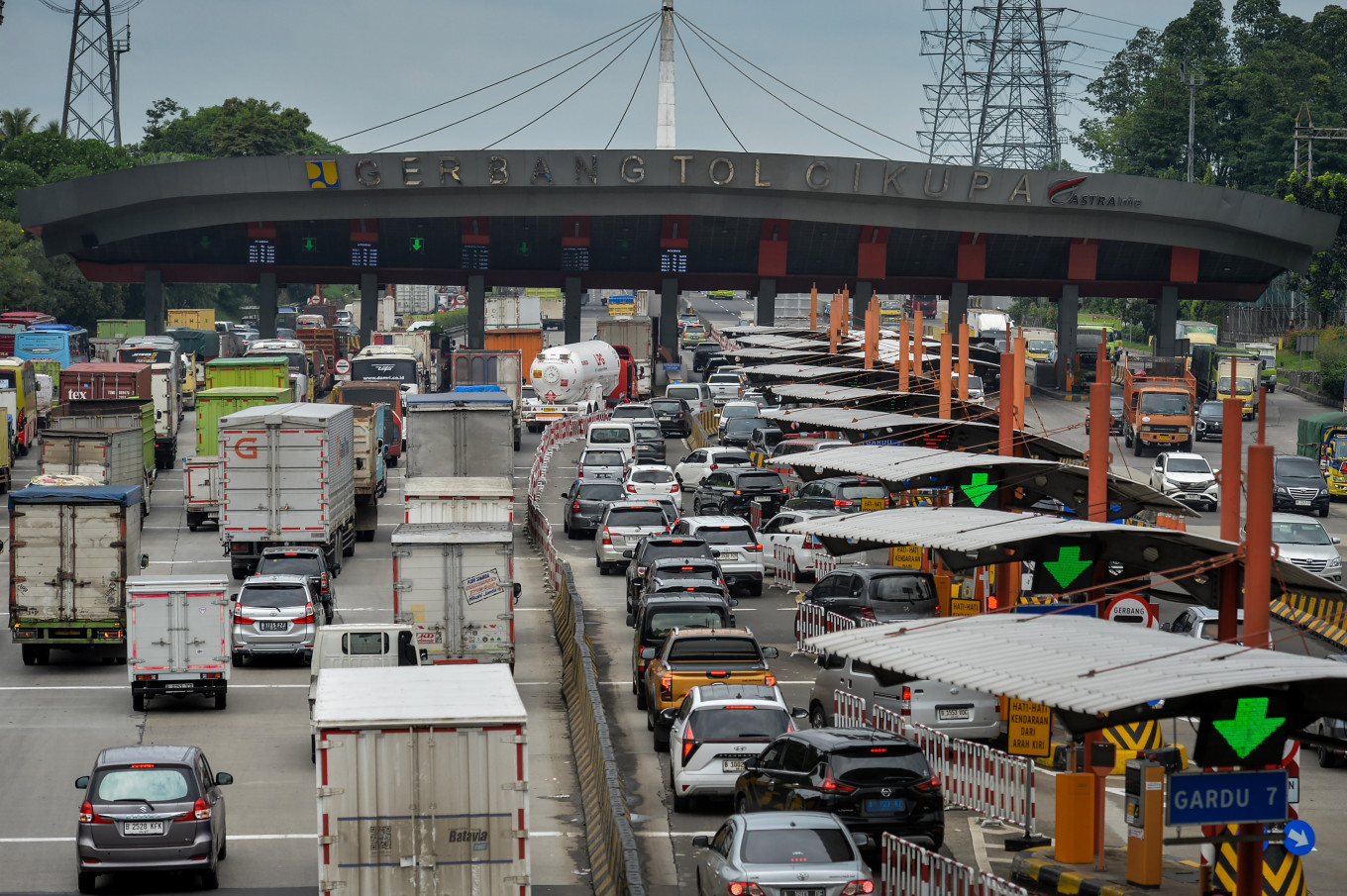 Vehicles line up to enter the Cikupa toll gate in Tangerang regency, Banten, on Dec. 24, 2025. (Antara/Putra M. Akbar)
T
he government’s plan to impose value added tax (VAT) on toll road services may look like an easy way to raise revenue, but it is a high-risk gamble. While the gain for the state budget is modest, the potential damage to logistics costs, inflation and national competitiveness could be significant. This is not a minor technical tweak in tax objects; it is a fundamental shift in how the state treats public mobility and the backbone of national distribution.
The proposal is currently embedded in the Directorate General of Taxes’ Strategic Plan for 2025–2029, with implementation targeted for 2028. Yet, the policy has moved forward on paper faster than it has been tested politically or economically.
The recent intervention by Finance Minister Purbaya Yudhi Sadewa, who admitted he had not been fully briefed and called for a revalidation by the Fiscal Policy Agency (BKF), reveals a worrying gap. A levy affecting nearly every truck and commuter has advanced further in bureaucratic planning than in public debate.
The fiscal arithmetic must be seen in context. National toll road revenues are estimated at roughly Rp 40 trillion (US$2.3 billion) to Rp 42 trillion annually, reflecting the resilience of toll assets on major freight corridors. At an 11 percent VAT rate, the state might collect around Rp 4.4 trillion to Rp 4.7 trillion.
While significant, this is a small fraction of the Rp 2.36 quadrillion national tax target. The key question is whether this incremental gain justifies the risk of a logistics-driven inflationary chain reaction.
For logistics companies, toll fees are not a luxury; they are a fixed operational cost. Heavy freight vehicles cannot simply abandon toll roads for alternative routes without jeopardizing delivery schedules, fuel efficiency and safety. Toll traffic for goods is relatively inelastic: when charges rise, trucks still pass through and the cost is passed on.

Layering an 11 percent tax on top of toll rates that already undergo biennial adjustments creates a multi-layered burden on a sector with thin margins. These costs will inevitably be built into the prices of basic staples like rice, cement and industrial raw materials.