TheJakartaPost
Please Update your browser
Your browser is out of date, and may not be compatible with our website. A list of the most popular web browsers can be found below.
Just click on the icons to get to the download page.


Popular Reads
Top Results
No results found. Please check your search term and try again
Can't find what you're looking for?
View all search results
Popular Reads
Top Results
No results found. Please check your search term and try again
Can't find what you're looking for?
View all search resultsTransiting to a more stable, inclusive planetary order
Each economy, locality or culture must be hard-nosed that their different geography, resource-endowment, human talent and governance capacity means that they have to address the common problems in diverse ways.
Change text size
Gift Premium Articles
to Anyone
Share the best of The Jakarta Post with friends, family, or colleagues. As a subscriber, you can gift 3 to 5 articles each month that anyone can read—no subscription needed!
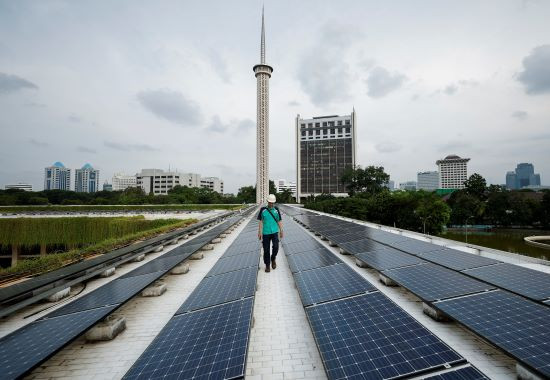
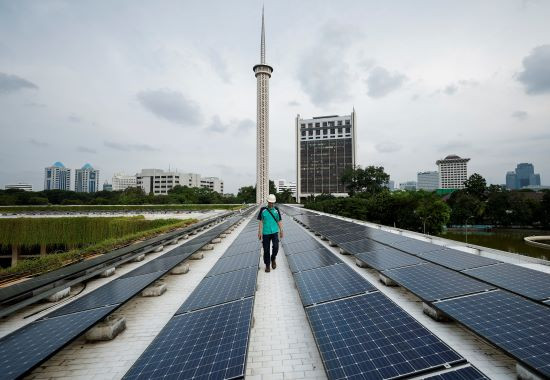 A technician walks on March 26, 2024, between solar panels that partially provide electrical power to Istiqlal Mosque in Central Jakarta. (Reuters/Willy Kurniawan)
T
he old order is being destroyed before our eyes. With volatility players making billions from United States President Donald Trump’s war-on, war-off announcements on the US-Israeli war against Iran, the rest of us are finally convinced that geopolitical rivalry is all about who controls energy, water, food and technology. Geography and ego determine destiny.
With China and Russia standing by to see how much their rivals can self-damage, Trump and Israeli Prime Minister Benjamin Netanyahu have demonstrated that those who commit genocide ultimately commit moral suicide. It’s funny that the US Department of War is requesting US$200 billion to wage the war, whilst the Iranians are claiming $270 billion in war damage reparations.
So far, no one has calculated the real losses to the Gulf States, Lebanon, Jordan, Gaza, let alone the energy-starved developing countries. Wouldn’t it be cheaper for all just to settle for peace?
War aside, adults who care about peaceful long-term stability have to address the perennial tough transitions to a more just, inclusive and ecologically sustainable global order. Idealism is being shattered by hard realism that we cannot go down the linear trajectory of ruthless consumption faster than the planet can heal.
This is the stark message in the 2026 Circularity Gap Report, funded by the Circle Economy Foundation in Amsterdam to “help businesses, cities, and nations thrive in the circular economy so they can stay competitive, build resilience, and create lasting value.” The circular economy is theoretically sound. But practice and implementation is the hard part. The old find it hard to change; the young are not empowered to make change.
In the realist, raw capitalist world of endless consumption, funded by borrowing from the future, a circular economy stands in stark contrast to the linear production and consumption that wastes natural resources without accountability. Describing, complaining about the lack of measurement or lack of impact, the increasing fragmentation and deterioration in human wellbeing and planetary health testify that theory is far from solving our systemic, entangled gridlock.

As Canadian Prime Minister Mark Carney astutely pointed out for the old order: “Hope is not a plan; Nostalgia not a strategy.” We are already too late to achieve the NetZero goals based on current national commitments. With split geopolitical camps, we have neither enough multilateral money nor political will to deal with the systemic issues as a whole.
Reading the Boao Forum: Sustainable Development and Annual Report 2026 brought for me a breath of fresh air away from wishful thinking. Instead of wishing that states or businesses would do something about NetZero, the Report suggests a distinctive "unity-in-diversity" approach to achieving sustainable development goals.
The report recognized that no economy faces the same problems as others. Each economy, locality or culture must be hard-nosed that their different geography, resource-endowment, human talent and governance capacity means that they have to address the common problems in diverse ways. To address Asian challenges, the Boao report identified energy transition, digitalization, and cross-border connectivity as “break-through points” for change.
You can’t change everything at once. Focus on areas where you can make a difference. In essence, allow diverse competition to evolve an ecologically sustainable and inclusive "Asian Wellbeing” that are networked into regional collective advantages through Asian platforms from technological and financial innovation.
To achieve real change at the ground level, Asian institutions must adapt and not simply repeat the old Bretton Woods model that is both underfunded and over-bureaucratized. A core reason why multilateral development banks have not made much difference on inclusivity and sustainable development is that they assume that Western models of governance and market principles are universal in application.
The challenge for Asian multilateral banks like the Asian Development Bank and Asian Infrastructure Investment Bank (AIIB) is to shift operationally on how to help Asian governments and businesses design, implement and operate green and inclusive projects and programs that have impact on rural and urban poverty, regenerate forests, rivers, seas and water sources, produce green energy and promote talent building through learning by doing.
The old order assumed that the best and brightest reside in Washington, London or Brussels. The countries with the best practical experience in hard development are in Asia, China, India and ASEAN countries, with much practical knowledge and experience to share, without the baggage of legacy mindsets. North Asia has all the surplus savings, technology and management experience in global manufacturing, supply chains and world-class infrastructure.
Asia should not preach, but practice green, inclusive growth in her own backyard first. The Global South has woken up to the fact that trust can only be generated through action, not just words. Theory and ideology is being replaced by practical realities that you have to own and implement change that best fit your needs.
Strategies and flexible, pragmatic execution towards goals of inclusive and green wellbeing can only be implemented by national and local market institutions, augmented by regional platforms that adjust to changing conditions. You build sustainability and resilience from the bottom-up, and then network to scale through different types of platforms and institutions.
There is no glamor in building long-lasting institutions for the good of the community. We don’t need daily haranguing from political pulpits. We just need better roads, water, food and energy within the limits of our needs, shared justly. That is what Asia can deliver, quietly and without fuss. Only then will we have the moral foundations for global respect.
---
The writer is a distinguished fellow of Asia Global Institute, University of Hong Kong, China, and chairman of the George Town Institute of Open and Advanced Studies, Wawasan Open University in Penang, Malaysia, The views expressed are personal.