TheJakartaPost
Please Update your browser
Your browser is out of date, and may not be compatible with our website. A list of the most popular web browsers can be found below.
Just click on the icons to get to the download page.


Popular Reads
Top Results
No results found. Please check your search term and try again
Can't find what you're looking for?
View all search results
Popular Reads
Top Results
No results found. Please check your search term and try again
Can't find what you're looking for?
View all search resultsRewriting police law, hijacking reform, reversing social contract
The proposed amendments of the Police Law bypass systemic upstream reforms in favor of executive discretion, transforming a narrow safety valve into a tool for political capture.
Change text size
Gift Premium Articles
to Anyone
Share the best of The Jakarta Post with friends, family, or colleagues. As a subscriber, you can gift 3 to 5 articles each month that anyone can read—no subscription needed!
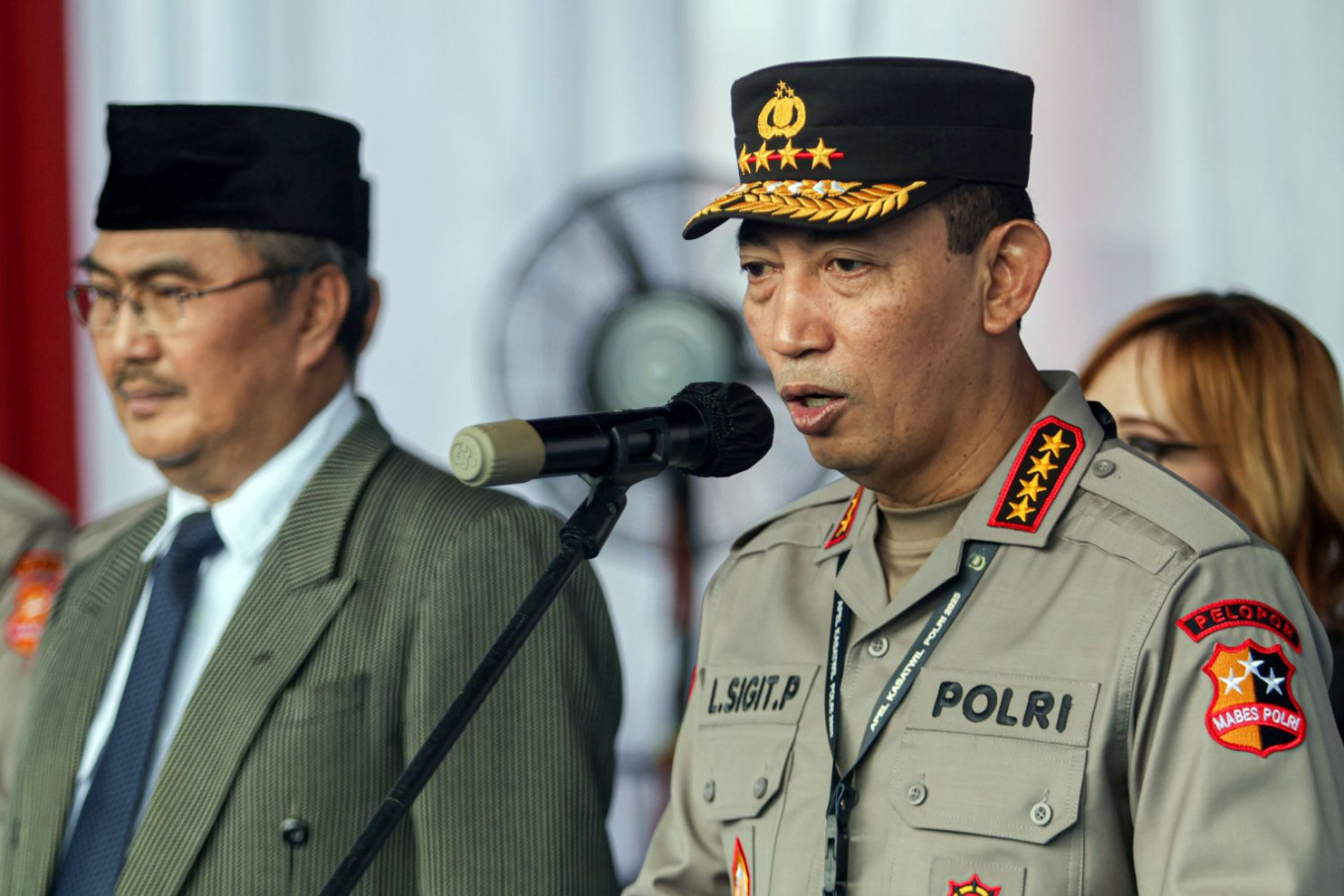 Law and enforcement: National Police chief Gen. Listyo Sigit Prabowo (right) addresses a press conference alongside Police Reform Acceleration Committee chairman and former Constitutional Court chief justice Jimly Asshiddiqie on Nov. 24, 2025, following an event at the National Police’s Mobile Brigade Training Center in Cikeas, Bogor, West Java. (Antara/Yulius Satria Wijaya)
T
he Jakarta Post’s report, "House-backed police bill opens way for Listyo's tenure extension" (May 26, 2026), raises a controversy that runs deeper than legislative technicalities: the revision to the Police Law now before the House of Representatives could extend the tenure of National Police chief Gen. Listyo Sigit Prabowo.
Among the seven changes cited by House Commission III chair Habiburokhman, Article 30 is the most consequential, raising the retirement age of four-star generals from 58 to 60, with an extension of up to three further years "according to the President's needs," for a potential total of 63.
The issue is not merely the numbers. Under the current law, Listyo must retire in 2027; should the revision pass, he could remain until 2029 or beyond, depending on the President's discretion. The phrase "according to the President's needs" opens the office of the police chief to structural politicization. This is what some observers read as a de facto lex specialis, a rule that appears general but is engineered to serve one particular interest.
Listyo carries political capital that spans administrations: from Surakarta police chief to presidential adjutant, head of the Criminal Investigation Agency, and finally police chief in January 2021, and he was retained when power passed to Prabowo Subianto. Such capital lets one figure navigate parliament while slowing the momentum of the Police Reform Acceleration Committee's (KPRP) recommendations.
Critics argue the draft revision runs counter to the reform agenda the government has championed. Listyo has promoted his "Presisi" (precision) program as a banner of modernization, yet his tenure has been repeatedly marred by impunity, abuse of power and brutality. The fundamental question therefore sharpens: Is this revision driven by long-term institutional need, as the KPRP found, or is it merely legal engineering to retain a particular figure? The question matters because reform reduced to a legislative product is precisely the hollow reform scholars of policing have warned against.
Two frameworks deserve weighing. The first comes from within the police itself. Brig. Gen. Ahrie Sonta, who holds a doctoral degree in police science, argued in "More than just police reform: A social contract for policing" (the Post, March 17, 2026) that policing is, in essence, a social contract.

Society demands safety and the rule of law; in return, it grants the police the legitimacy to use force. Genuine reform, therefore, is not about new rules but about the recognition that policing is a public trust, renewed daily through the professional conduct of officers.