TheJakartaPost
Please Update your browser
Your browser is out of date, and may not be compatible with our website. A list of the most popular web browsers can be found below.
Just click on the icons to get to the download page.


Popular Reads
Top Results
No results found. Please check your search term and try again
Can't find what you're looking for?
View all search results
Popular Reads
Top Results
No results found. Please check your search term and try again
Can't find what you're looking for?
View all search resultsStrengthening tax capacity: The foundation of fiscal future
To fund its ambitious development goals without crashing the economy, Indonesia must shift its focus from raising tax rates to fixing the fragmented institutional machinery required to collect them.
Change text size
Gift Premium Articles
to Anyone
Share the best of The Jakarta Post with friends, family, or colleagues. As a subscriber, you can gift 3 to 5 articles each month that anyone can read—no subscription needed!
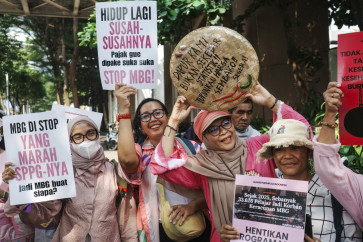
![Women hold up posters that read, “Life is still hard [while] my taxes are used as they like. Stop MBG,” during a protest in Jakarta on June 18, 2026, calling for a review of the free nutritious meal (MBG) program, lower fuel prices and create more jobs for women. (AFP/Bay Ismoyo)](https://img.jakpost.net/c/2026/06/28/2026_06_28_177077_1782607421._large.jpg) Women hold up posters that read, “Life is still hard [while] my taxes are used as they like. Stop MBG,” during a protest in Jakarta on June 18, 2026, calling for a review of the free nutritious meal (MBG) program, lower fuel prices and create more jobs for women. (AFP/Bay Ismoyo)
Women hold up posters that read, “Life is still hard [while] my taxes are used as they like. Stop MBG,” during a protest in Jakarta on June 18, 2026, calling for a review of the free nutritious meal (MBG) program, lower fuel prices and create more jobs for women. (AFP/Bay Ismoyo)
F
ormer finance minister Chatib Basri recently remarked, with characteristic humor, that a finance minister’s job is remarkably simple: Increase revenue, reduce spending and cut the budget selectively.
While delivered lightheartedly, the statement captures a fundamental reality. The essence of fiscal policy revolves entirely around balancing public revenue and expenditure. Governments require sufficient resources to finance development priorities while maintaining long-term fiscal sustainability.
Today, however, balancing this equation has become increasingly difficult.
Indonesia, like many developing nations, faces compounding spending pressures. Infrastructure requires continuous investment, human capital development remains a critical priority, and programs spanning food security, social protection, rural development and education demand significant public resources. At the same time, maintaining strict fiscal discipline is nonnegotiable if the state is to preserve economic stability and investor confidence.
These spending pressures will inevitably intensify. President Prabowo Subianto’s administration has introduced several ambitious priority initiatives such as the free nutritious meal (MBG) program, the Sekolah Nasional Terintegrasi (integrated national school) initiative for educational quality expansion and the Red and White Cooperatives program for rural revitalization.
While these investments have the potential to generate profound, long-term social and economic benefits, the primary challenge is not whether these priorities are worthwhile but how to finance them sustainably.

Under these circumstances, the conventional response is to seek immediate avenues for increasing tax revenue. Yet raising tax rates is an increasingly unviable strategy in a global environment characterized by sluggish economic growth, business uncertainty and fierce international competition for investment.


![Women hold up posters that read, “Life is still hard [while] my taxes are used as they like. Stop MBG,” during a protest in Jakarta on June 18, 2026, calling for a review of the free nutritious meal (MBG) program, lower fuel prices and create more jobs for women. (AFP/Bay Ismoyo)](https://img.jakpost.net/c/2026/06/28/2026_06_28_177077_1782607421._medium.jpg)