TheJakartaPost
Please Update your browser
Your browser is out of date, and may not be compatible with our website. A list of the most popular web browsers can be found below.
Just click on the icons to get to the download page.


Popular Reads
Top Results
No results found. Please check your search term and try again
Can't find what you're looking for?
View all search results
Popular Reads
Top Results
No results found. Please check your search term and try again
Can't find what you're looking for?
View all search resultsIs India Asia's ultimate 'anti-AI' trade?
As Asia's AI-fueled stock boom cools, a supposed “AI loser” is emerging from the wreckage as an unlikely haven: India.
Change text size
Gift Premium Articles
to Anyone
Share the best of The Jakarta Post with friends, family, or colleagues. As a subscriber, you can gift 3 to 5 articles each month that anyone can read—no subscription needed!
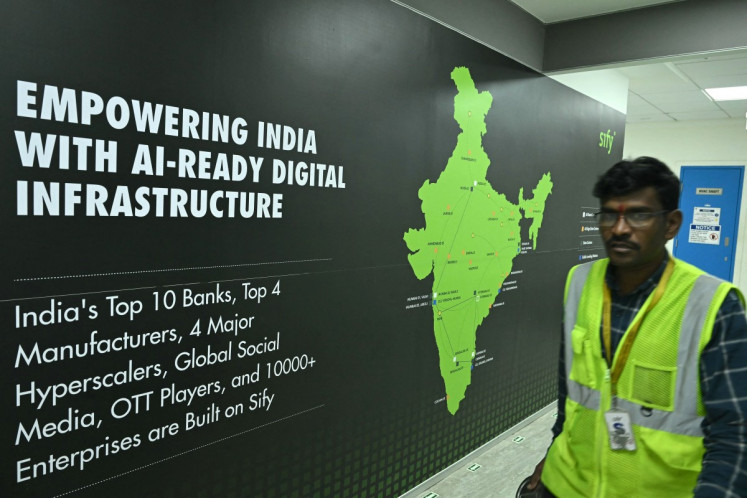
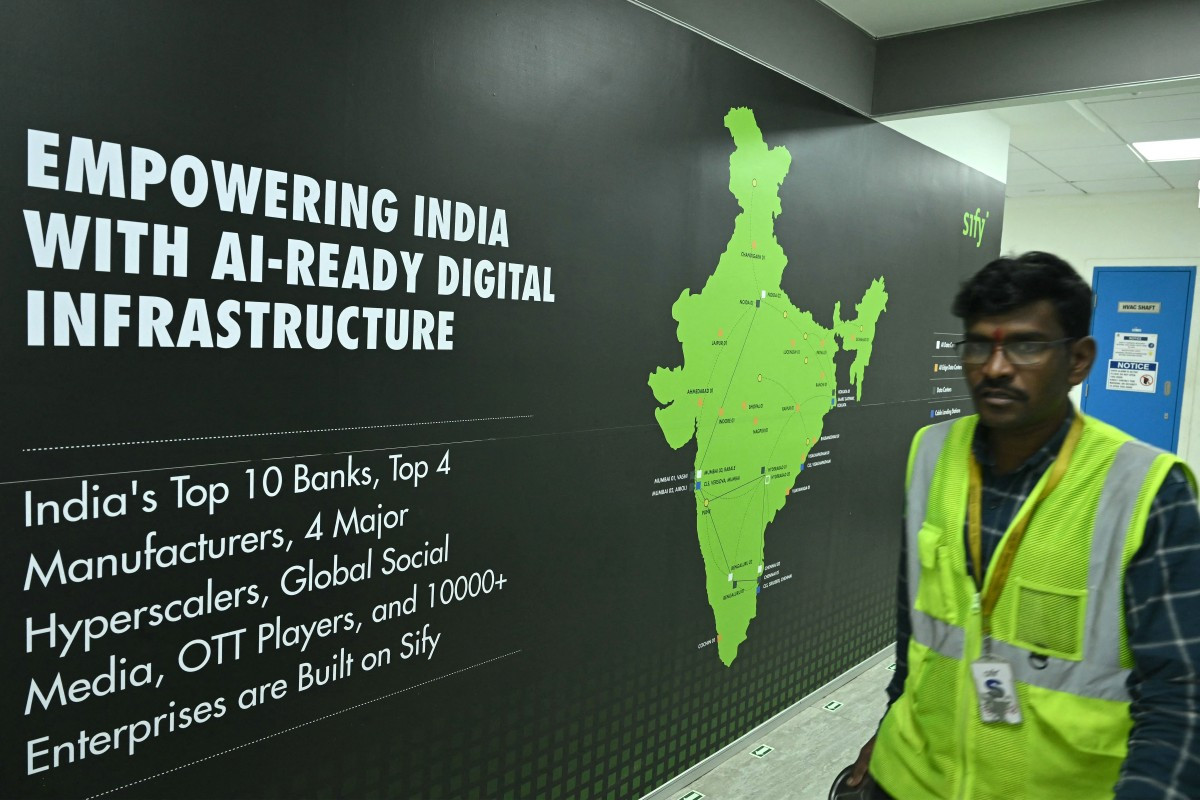 A man walks past signage of Sify Infinit Spaces at its data center at Rabale in Navi Mumbai, India, on July 20, 2026. (AFP/Indranil Mukherjee)
A
s Asia's artificial intelligence-fueled stock boom cools, a supposed “AI loser” is emerging from the wreckage as an unlikely haven: India.
Indian equities' lack of direct AI exposure, whether to creators of large language models or semiconductor and chip manufacturers, dampened foreign investors' enthusiasm for the country's stocks for much of 2025 and 2026, as money instead flooded into South Korea and Taiwan's tech-saturated markets.
But that trend has shifted this summer.
Since mid-June, equities in South Korea and Taiwan have stumbled, reflecting rising anxieties about the durability and profitability of massive AI capital expenditures. Meanwhile, India's benchmark stock index has climbed 5 percent as money has pivoted to a perceived "anti-AI" trade.
This remains a modest change. The benchmark indices in South Korea and Taiwan are up around 90 percent and 80 percent, respectively, over the past 12 months, compared with being down 5 percent for India.
But this recent rotation may be more than just a short-term defensive move, as it comes at a fortuitous time for India, coinciding with several tailwinds in the domestic economy. At the same time, India is finding its place in the AI ecosystem, meaning it could turn out not to be an anti-AI trade after all, but a different, less concentrated type of tech bet.

Recent macroeconomic data in India has been encouraging on several fronts. Accelerating bank loans and fixed-asset investment signal a pick-up in both consumption and investment. More broadly, annualized real gross domestic product growth of 7.8 percent in the first quarter has kindled expectations that the 6.6 percent and 6.4 percent growth forecasts for 2026 from the World Bank and the International Monetary Fund will be outpaced.
Foreign portfolio investments are reviving, too. While overseas investors sold US$29 billion of Indian equities in the first half of the year, they then turned around to buy $1.7 billion in the first few weeks of July.
Foreign investment in Indian fixed income had already recovered in the prior month. This was likely in response to several government policies, including exempting foreigners from paying withholding tax and capital gains tax on government securities. Another measure to reduce foreign exchange hedging costs for Indian commercial banks serving foreign accounts is widely expected to mobilize about $50 billion in deposits from non-resident Indians.
Those inflows into Indian markets, in turn, could help stabilize the volatile rupee. This currency is down 6.5 percent against the United States dollar so far in 2026, though it briefly recovered 2.6 percent after the US-Iran ceasefire in March before sliding again in late June.
Last but not least, consensus earnings for India's largest companies are rising in several sectors. According to FactSet, consensus earnings-per-share estimates for India's financials, telecommunications, process industries, consumer services and basic materials have been upgraded over the past month, reversing a trend of consistent downgrades over the past two years.
India's "anti-AI" moniker may also be a bit too simplistic, as the technological revolution is not bypassing the country.
While it is true that India's large call service and back office industry is highly vulnerable to AI disruption, that is only one side of the AI equation.
India appears to be evolving into one of the key locations where AI is being deployed at scale. Fueled by a massive, multilingual population, ubiquitous smartphone access and highly affordable data, mass usage of AI is soaring across Indian cities, according to a recent report by the ADP Research Institute. The report finds that over 40 percent of Indian employees report using AI every day, double the global average.
In turn, investment from global AI providers in infrastructure in India is also accelerating. This includes spending on high-performance servers, power generation and transmission equipment, and industrial cooling.
Over the next five years, the massive tech infrastructure outlays in India include $57 billion collectively by Google, Microsoft and Amazon, $100 billion by Adani Group and $30 billion by Blackstone. These figures underscore the scale of the India market, home to the world's most populous country, which has a median age under 30.
The appropriate categorization of the Indian market's relationship with AI is therefore not "anti-AI" but "anti-AI-concentration".
While things are looking better for Indian equities, a sustained rally is by no means a slam dunk.
The recent dismantling of the US-Iran ceasefire agreement and resumption of military conflict, accompanied by a spike in oil prices, is a reminder of the macroeconomic risks that large energy importers like India face.
After Middle East hostilities flared up again in early July, Brent crude prices surged over 30 percent and the rupee fell against the dollar. Oil prices have since come down, but further volatility in energy prices is likely as a sustainable resolution to the US-Iran conflict still appears far off.
And crude prices are far from the only factor putting upward pressure on India's consumer price index. The 4.4 percent reading in June, which remains above the Reserve Bank of India’s (RBI) medium-term midpoint target of 4 percent, was driven largely by food prices, and that inflationary pressure may intensify given India's weak monsoon season. That, in turn, could trigger the onset of a rate-hiking cycle by the RBI.
Indian equities have had a few good weeks. Whether that can translate into a true shift in investor positioning will depend on how worried investors truly are about AI-concentrated markets and also how the technological and geopolitical ructions of the past six months impact India itself.
---
The writer is founder and CEO of Emmer Capital Partners Ltd. The views expressed are personal