The Jakarta Post
Please Update your browser
Your browser is out of date, and may not be compatible with our website. A list of the most popular web browsers can be found below.
Just click on the icons to get to the download page.


Popular Reads
Top Results
No results found. Please check your search term and try again
Can't find what you're looking for?
View all search results
Popular Reads
Top Results
No results found. Please check your search term and try again
Can't find what you're looking for?
View all search resultsBreaking the vicious cycle of forest fires and haze
Satellite dots and convenient scapegoats won't stop the haze, breaking the country’s fire crisis demands trading assumptions for real accountability on the ground.
Change text size
Gift Premium Articles
to Anyone
Share the best of The Jakarta Post with friends, family, or colleagues. As a subscriber, you can gift 3 to 5 articles each month that anyone can read—no subscription needed!
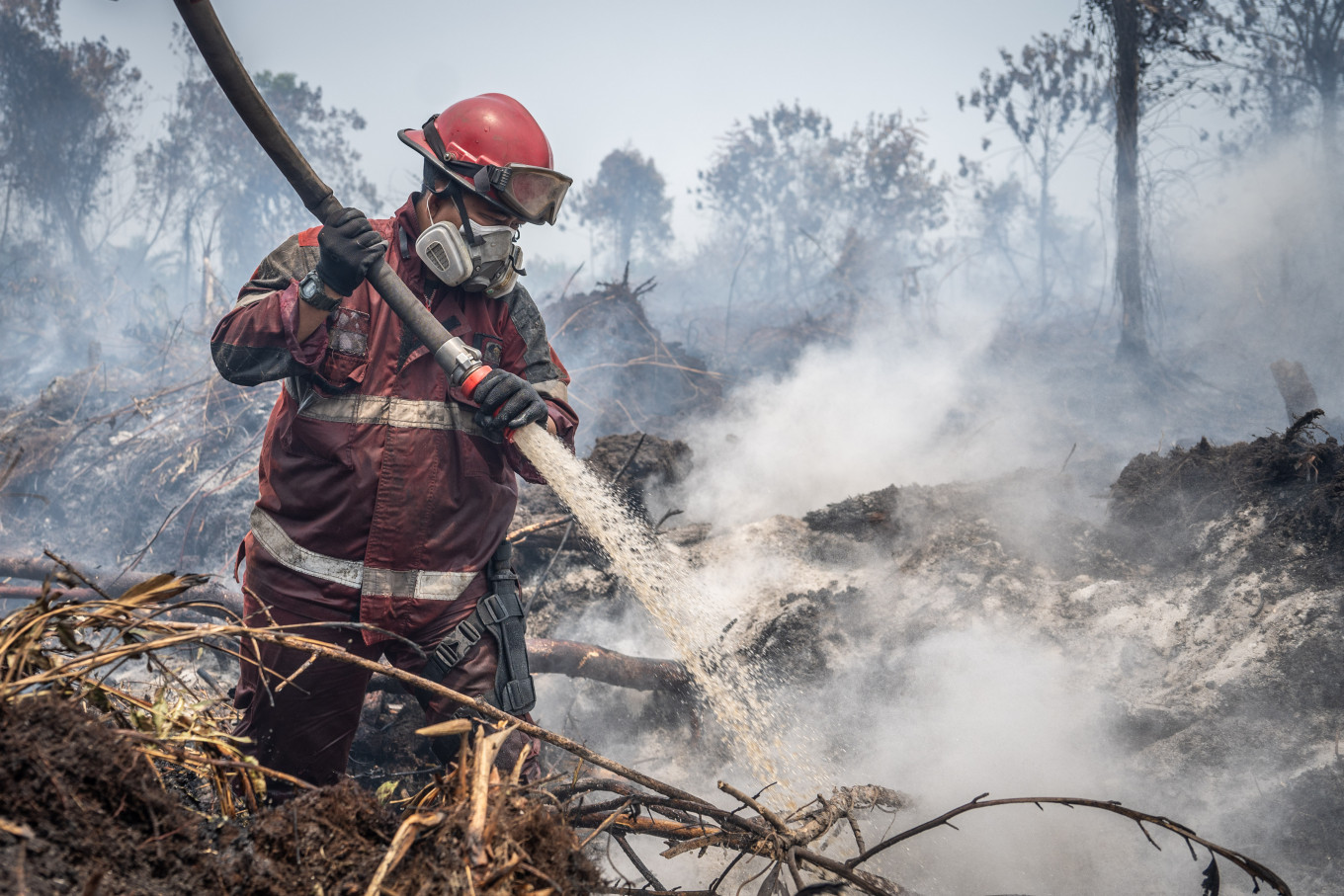 A fireman extinguishes a peatland fire on Aug. 24, 2026, in Kampar regency, Riau. The Riau provincial administration and other agencies reduced the area affected by forest and land fires from about 16,000 to 900 hectares between January and August 2026. (Antara/Bayu Pratama S)
H
otspots are reappearing across the country before the dry season has even peaked, reigniting an old debate: Who should be held accountable?
Satellite data as of this month shows just how serious the threat is. More than 2,900 hotspots were detected in Sumatra and Kalimantan. The former recorded over 1,000 hotspots spread across various provinces. In Kalimantan, the number is even higher, dotting nearly all regions.
The haze always follows the same path, a blip on a satellite monitor turns into a column of smoke, soon swelling into a crisis far larger than the fire itself. Every severe dry spell plunges Sumatra and Kalimantan back into familiar dread. Yet the moment flames spread, public discourse rushes to assign blame, bringing genuine solutions to an immediate standstill.
Whenever the haze descends, palm oil plantations become the default target. They are the easiest suspects to name, often well before any formal investigation gets underway.
This does not mean the plantation industry should be placed outside the law. On the contrary, companies proven to have intentionally used fire to clear land or neglected their prevention obligations must indeed face strict legal consequences. Nonetheless, law enforcement also loses its meaning when the problem is oversimplified.
We must distinguish between those who set the fires, those who were negligent in preventing them, and those who were actually victims of the fire’s spread. A company whose land has burned is not necessarily the one that started the fire. Conversely, a fire originating outside the concession area does not automatically absolve the company of responsibility if it is proven that its prevention systems were inadequate. Lumping all three into a single category simply because the fire was found within the concession boundaries is potentially leading to injustice.

When a forest fire happens, the question that should be asked is not merely: Where was the fire detected? The more relevant questions are: Where did the fire come from? Who has control over that area? What actions were taken before the fire started, when it broke out, and after it was brought under control? These three questions may seem simple, but the answers determine the course of justice and compliance assessments. Without this process, forest fire management can easily devolve into policy based on assumptions.