The Jakarta Post
Please Update your browser
Your browser is out of date, and may not be compatible with our website. A list of the most popular web browsers can be found below.
Just click on the icons to get to the download page.


Popular Reads
Top Results
No results found. Please check your search term and try again
Can't find what you're looking for?
View all search results
Popular Reads
Top Results
No results found. Please check your search term and try again
Can't find what you're looking for?
View all search resultsCan QRIS digitize MSME credit?
The national standard for QR code payments has helped millions of small businesses move toward digital financial inclusion. The next step in this evolution is to use the data generated to enable access to financing.
Change text size
Gift Premium Articles
to Anyone
Share the best of The Jakarta Post with friends, family, or colleagues. As a subscriber, you can gift 3 to 5 articles each month that anyone can read—no subscription needed!
 Set as preferred source
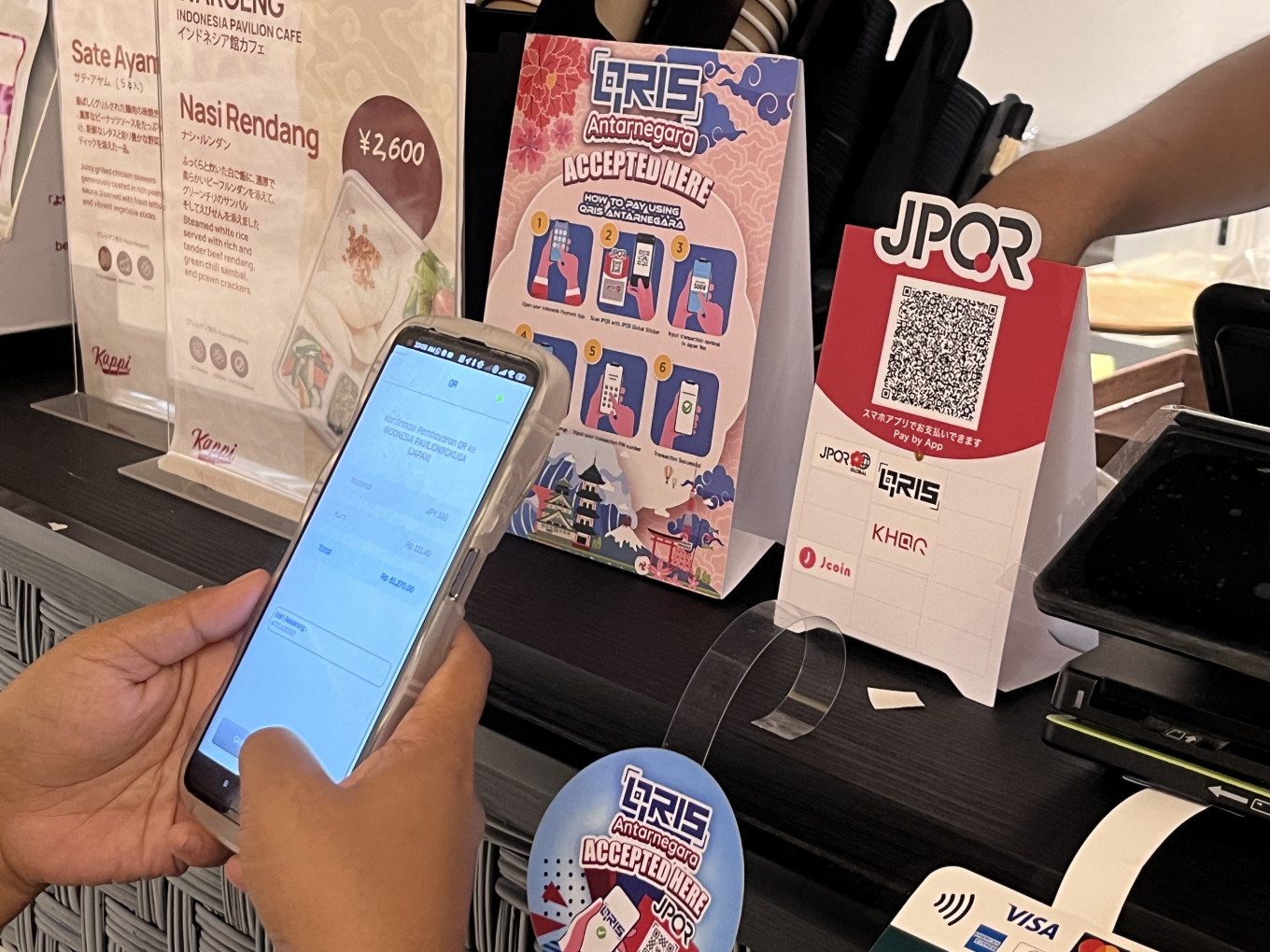 A customer scans Japan's unified QR code JPQR to make a payment using the Quick Response Indonesia Standard (QRIS) on Aug. 25, 2025, at World Expo 2025 in Osaka, Kansai, Japan. (JP/ Ni Made Tasyarani)
T
hrough Quick Response Code Indonesian Standard (QRIS), Indonesia has digitized how millions of small businesses get paid. The next frontier is transforming that digital footprint into trusted business intelligence to unlock formal credit.
As of June 2026, QRIS has reached 44.86 million merchants, 96.68 percent of which are micro, small and medium enterprises (MSMEs). In the first half of the year alone, the network processed 12.55 billion transactions valued at Rp 1.12 quadrillion (US$63 billion), marking a 93.92 percent increase year-on-year.
These figures represent far more than payment velocity: They form an expansive ledger of grassroots economic activity. Consequently, the central question is no longer whether Indonesia can digitize MSME payments but whether it can leverage that transaction volume to make small enterprises visible, legible and creditworthy.
QRIS solves payment acceptance; credit underwriting assesses the capacity and willingness to repay.
While many MSMEs boast steady foot traffic and reliable turnover, they routinely lack audited balance sheets, pledged collateral or conventional credit histories. Instead, their financial reality remains fragmented, dispersed across bank accounts, e-wallets, e-commerce platforms, supplier invoices and informal ledgers.
This structural opacity cannot be bridged by payment data alone. A merchant generating Rp 100 million in monthly QRIS volume is not inherently a prime borrower. Top-line throughput reveals little about net margins, inventory costs, working capital liquidity or seasonal demand swings. High turnover does not equal financial health.

The goal, therefore, is not to engineer a crude “QRIS credit score” but to construct meaningful cash flow intelligence. With an entrepreneur’s consent, lenders need visibility beyond raw payment volume to evaluate revenue volatility, customer concentration, operating cash flow, vendor obligations and existing debt loads.