The Jakarta Post
Please Update your browser
Your browser is out of date, and may not be compatible with our website. A list of the most popular web browsers can be found below.
Just click on the icons to get to the download page.


Popular Reads
Top Results
No results found. Please check your search term and try again
Can't find what you're looking for?
View all search results
Popular Reads
Top Results
No results found. Please check your search term and try again
Can't find what you're looking for?
View all search resultsWhat PISA keeps telling us about foundations
Indonesia’s latest PISA performance remains below the targets, but the broader trajectory contains genuine progress.
Change text size
Gift Premium Articles
to Anyone
Share the best of The Jakarta Post with friends, family, or colleagues. As a subscriber, you can gift 3 to 5 articles each month that anyone can read—no subscription needed!
 Set as preferred source
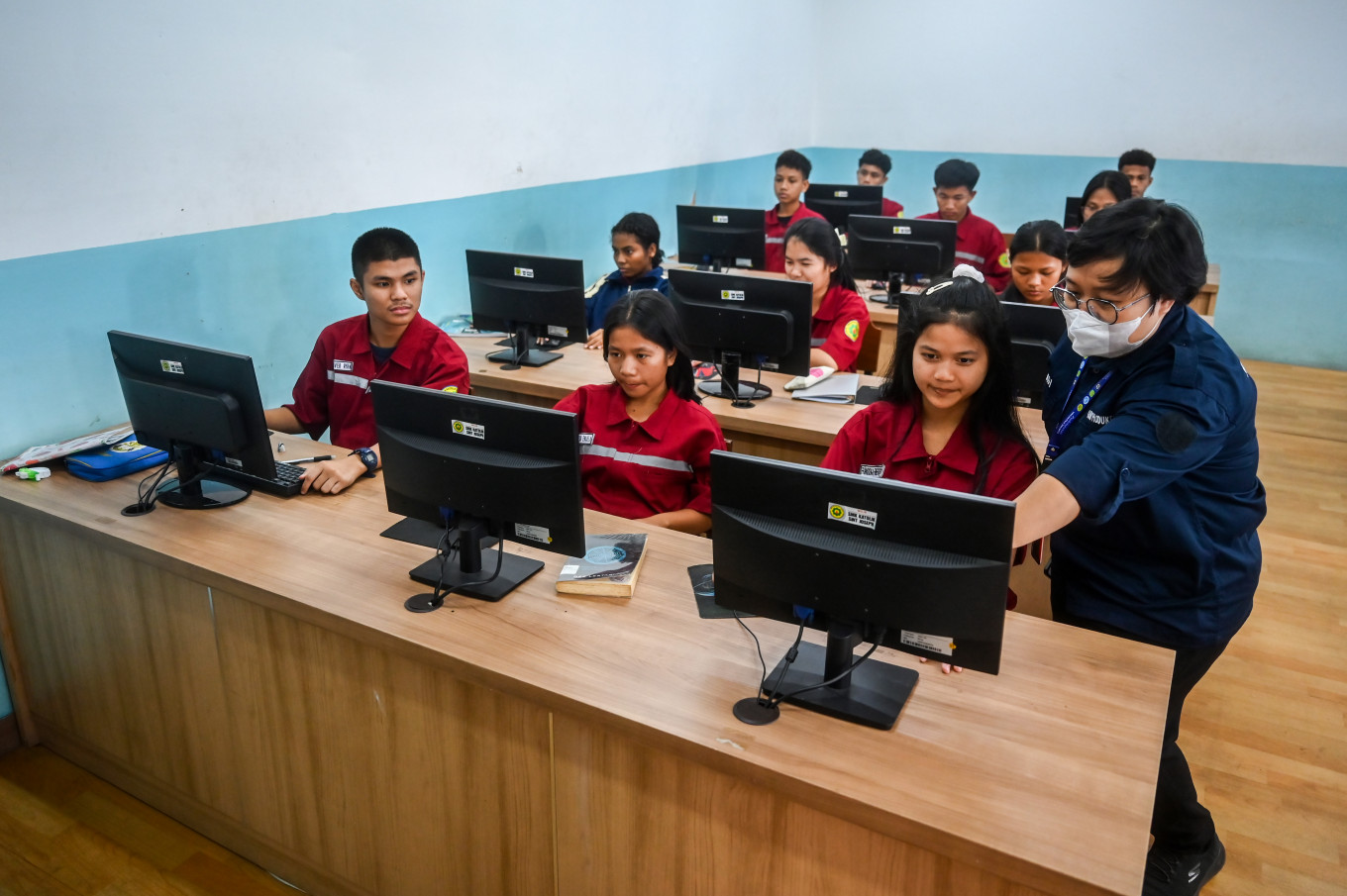 Designing the future: Students attend a visual communication design training session on April 13, 2026, at Saint Joseph Catholic vocational high school in Jakarta. (Antara/Rivan Awal Lingga)
A
ddressing the Australian Parliament following the release of the PISA 2025 results on Sept. 8, Education Minister Jason Clare praised England’s performance in the international assessment, in the United Kingdom. While scores across most Organisation for Economic Co-operation and Development (OECD) member states continued a post-pandemic decline, England held steady.
That stability produced a striking rise in its global rankings: climbing four places in reading, one in mathematics, and five in science. Clare termed the achievement “hard-earned”, the cumulative dividend of a disciplined, 14-year overhaul of early literacy instruction.
England’s trajectory offers a compelling case study in structural education reform. Commissioned after the 2001 Progress in International Reading Literacy Study (PIRLS) exposed wide achievement gaps for disadvantaged students, Sir Jim Rose’s independent review (2006) recommended systematic synthetic phonics as the primary method for early reading instruction from age five. This framework systematically teaches children to map individual letter-sound correspondences before blending them to decode words, establishing a mechanical decoding foundation prior to sentence-level reading.
In English-speaking jurisdictions, where orthography and phonology frequently diverge, this decoding capability is essential. Without a predictable method for sounding out text, pupils cannot independently parse unfamiliar vocabulary. Instead, they default to whole-word memorization or guessing from context clues, coping strategies that collapse as texts grow longer and linguistic complexity deepens.
Policy followed evidence. By 2007, the Labour government had mandated systematic synthetic phonics across all state-funded primary schools. In 2012, under the Conservative-led coalition, the policy gained diagnostic teeth with the introduction of a universal Phonics Screening Check for Year 1 pupils.
The reform yielded long-term empirical dividends. In PIRLS 2021, England rose to fourth globally, up from 19th in 2006, a sustained climb that survived ministerial turnover and political realignments. Emulating this trajectory, several Australian states introduced early-grade phonics checks in 2018, followed by a national Year 1 numeracy check introduced in 2025, with nationwide adoption anticipated by 2026.

During a visit to Australia last year, I observed these diagnostic assessments firsthand. Administered as a low-stakes, one-on-one session between a Year 1 pupil and their classroom teacher, the check takes between five and 10 minutes within a regular classroom setting. Conducted over a two-to-three-week window early in the second semester, the tool evaluates core phonemic awareness, basic decoding, and fundamental number sense. Crucially, it provides teachers with granular, immediate diagnostic data to guide small-group interventions before deficits harden.