The Jakarta Post
Please Update your browser
Your browser is out of date, and may not be compatible with our website. A list of the most popular web browsers can be found below.
Just click on the icons to get to the download page.


Popular Reads
Top Results
No results found. Please check your search term and try again
Can't find what you're looking for?
View all search results
Popular Reads
Top Results
No results found. Please check your search term and try again
Can't find what you're looking for?
View all search resultsWhere will Fed tightening hit hardest in Asia?
Asian economies are likely to see deepening diversion between countries with low inflation and those with spiraling inflation alongside heavy deficits amid headwinds from US monetary tightening.
Change text size
Gift Premium Articles
to Anyone
Share the best of The Jakarta Post with friends, family, or colleagues. As a subscriber, you can gift 3 to 5 articles each month that anyone can read—no subscription needed!
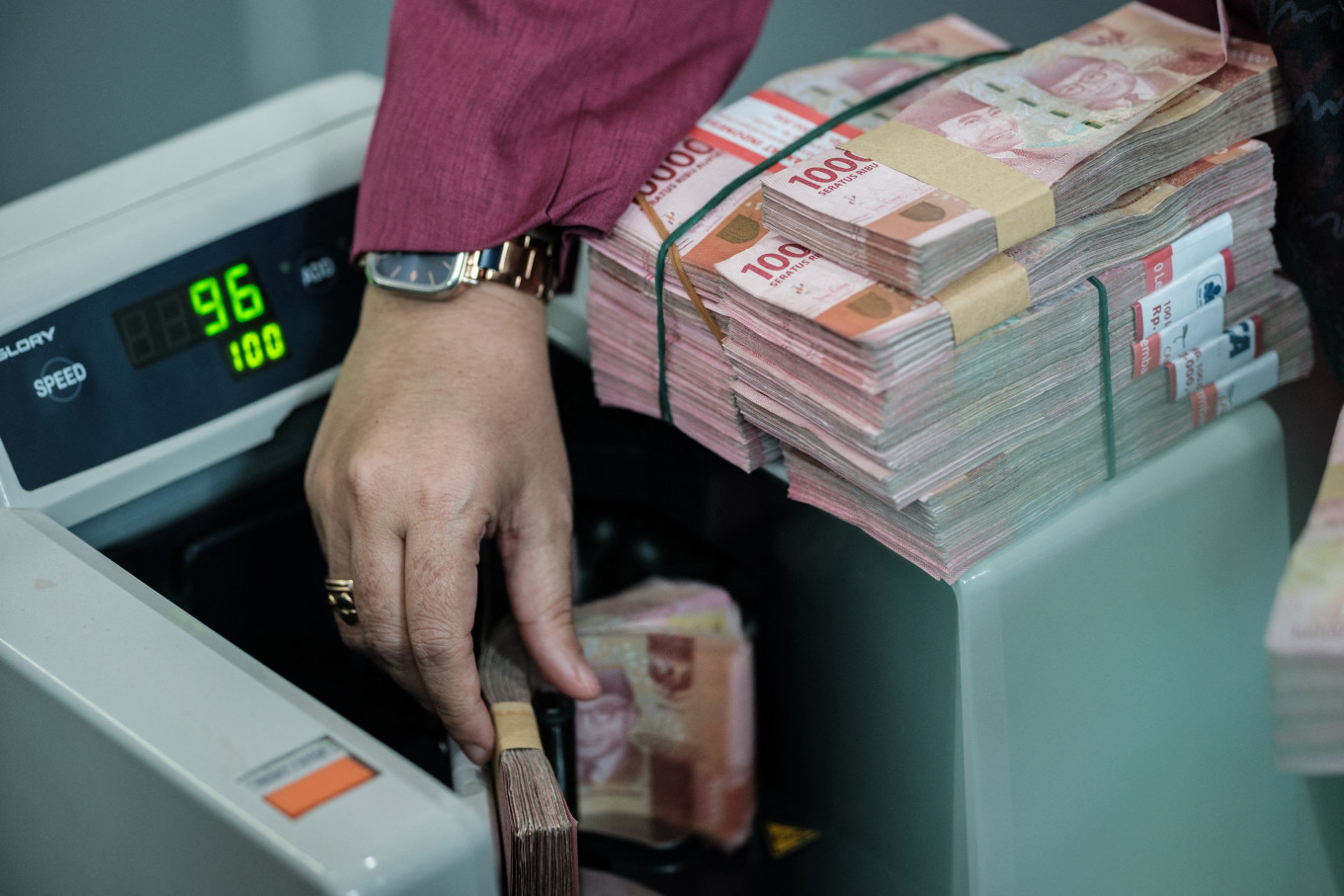 A teller places a bundle of Rp 100,000 banknotes in a money counting machine on June 4, 2026, at a currency exchange office in Jakarta. (AFP/Yasuyoshi Chiba)
A
s the United States monetary tightening cycle gets underway, Asian markets face a formidable headwind, yet the structural impact will diverge sharply by country and sector.
Federal Reserve chair Kevin Warsh announced on Sept. 16 that the US central bank was hiking its benchmark interest rate by 25 basis points (bps). But even more importantly, the Fed signaled that further increases could be coming to help combat inflation that has been above the 2 percent target for over five years.
Fed officials’ views, encapsulated in the so-called dot plot, indicate that one more rate hike is likely this year. Markets are meanwhile expecting as many as three more rate hikes through the middle of next year.
This hawkish shift in monetary policy is expected to affect Asian economies and financial markets through several interconnected channels, including by spurring capital outflows, weakening domestic currencies and bumping up inflationary pressures.
But the effects should be far from uniform across the region. Higher US yields can draw global investors to dollar-denominated assets, leading to capital flight from emerging Asian markets.
During the first 15 years of this century, US Treasury yields plummeted to ultralow levels, especially following the global financial crisis of 2008-2009. This triggered an avalanche of foreign capital into Asian equities.

However, that began to change during the COVID-19 pandemic in 2020, only to worsen following Russia's 2022 invasion of Ukraine, which compounded inflationary pressures and helped push rates higher. But it was the onset of the US-Israeli war with Iran this year that truly saw foreign investment flows into Asia collapse.
Driven by US 10-year yields hovering at 4-5 percent, estimated monthly foreign equity outflows reached a record US$192 billion through Sept. 25, far eclipsing the previous 2025 peak of $45 billion, based on data from Asian stock exchanges.
Predictably, many Asian currencies weakened significantly against the dollar during this period. Economies with current account deficits, such as India, Indonesia and the Philippines, were hit the hardest, as they rely heavily on foreign investments to finance their trade shortfalls.
Meanwhile, the currencies of economies running current account surpluses, like China and South Korea, have appreciated. Obviously, other factors are at play here, especially in China, which doesn’t have a freely floating currency, but the pattern still holds.
All of this suggests that if US interest rates continue to rise, the currencies of deficit economies could continue to slide further.
Depreciating local currencies typically fuel imported inflation. In the current episode, this dynamic is amplifying many other domestic price pressures impacting Asian economies, including the global energy supply shock and the El Nino weather pattern.
Deficit countries in Asia with weak currencies are, unsurprisingly, seeing some of the highest levels of inflation. At the end of August, inflation stood at 4.8 percent in India, 3.2 percent in Indonesia and 6.1 percent in the Philippines.
These countries have also already notched multiple rate hikes this year. Since May, Bank Indonesia has hiked rates three times by 100 bps cumulatively, while the Philippines' central bank has done so three times since April for a combined increase of 75 bps.
China, Taiwan and Malaysia remain Asia's notable inflation exceptions. This reflects weak domestic demand in China, while Taiwan and Malaysia have enjoyed relatively stable exchange rates and tariff cuts, meaning pressure on their central banks to hike rates is virtually nonexistent.
Equity market valuations are also at risk across the region. Over the past decade, three instances of rising yields in Asia have been accompanied by declines in forward price-to-earnings (PE) multiples in various Asian equity markets, as rising discount rates have mechanically dragged down valuations.
In the present episode, as the average 10-year yield in Asia rose from 3.4 percent in late October 2025 to 4.2 percent in late September 2026, the 12-month forward PE multiple for the FactSet Asia Market Index declined from 16.7 to 12.5 times. This trend could clearly worsen if US rates rise more than markets currently expect.
Different sectors should react differently, however.
“Long-duration” equities, meaning companies whose value primarily resides far out in the future, obviously tend to see their valuations fall more due to the rising cost of capital.
Technology often falls in this category. It’s unsurprising, therefore, that the PE multiples of the South Korean and Taiwanese markets, which are dominated by tech giants like Samsung, SK Hynix and TSMC, have declined the most during the latest US yield surge.
Soaring interest rates also jeopardize sectors dependent on high leverage or credit-driven demand. This hits capital-intensive industries like real estate and utilities facing higher refinancing costs, alongside consumer discretionary stocks constrained by tighter household borrowing.
The most leveraged markets are the Philippines, Thailand and China, which had net debt-to-equity ratios in 2025 of 118 percent, 105 percent and 86 percent, respectively, according to FactSet.
Banks and insurers, on the other hand, are usually the winners during global rate tightening cycles. For banks, lending rates typically outpace deposit rates, boosting net interest margins. That was evident in the 2022-2023 cycle, when the average net interest margin for Hong Kong's top 10 banks climbed from 1.41 to 1.65 percent.
Insurance companies, meanwhile, can keep investing their new premium income in progressively higher-yielding bonds as rates rise, typically boosting their profitability.
Markets with heavy financial weightings according to FactSet, led by Singapore at 47 percent of the market, Hong Kong at 32 percent, Malaysia at 31 percent and India at 26 percent, stand to benefit the most from these dynamics.
As rising capital costs reshuffle Asia’s economic deck, a sharp line is being drawn between resilient, low-inflation Asian economies and those burdened by heavy deficits and spiraling inflation. That line could deepen in the coming months.
---
The writer is founder and CEO of Emmer Capital Partners Limited. The views expressed are personal.