The Jakarta Post
Please Update your browser
Your browser is out of date, and may not be compatible with our website. A list of the most popular web browsers can be found below.
Just click on the icons to get to the download page.


Popular Reads
Top Results
No results found. Please check your search term and try again
Can't find what you're looking for?
View all search results
Popular Reads
Top Results
No results found. Please check your search term and try again
Can't find what you're looking for?
View all search resultsAnalysis: RI’s illegal cigarette trade A problem of enforcement and incentives
Change text size
Gift Premium Articles
to Anyone
Share the best of The Jakarta Post with friends, family, or colleagues. As a subscriber, you can gift 3 to 5 articles each month that anyone can read—no subscription needed!
 Set as preferred source
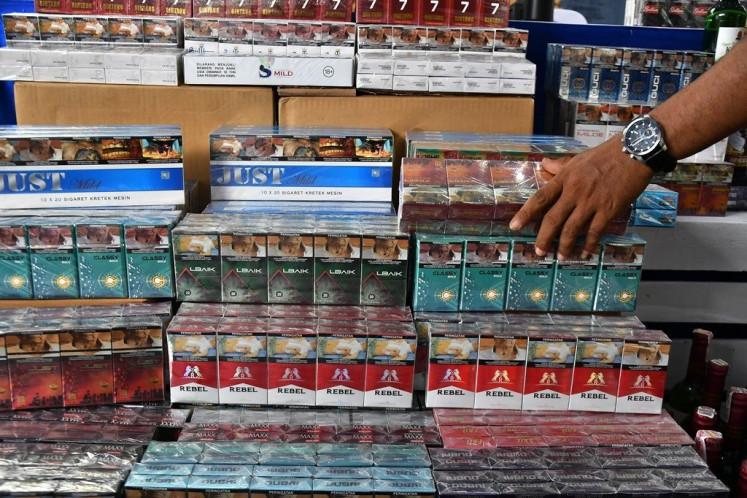
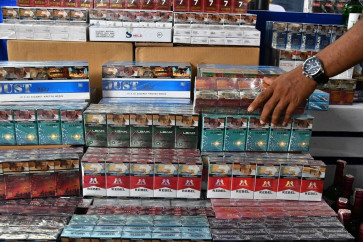
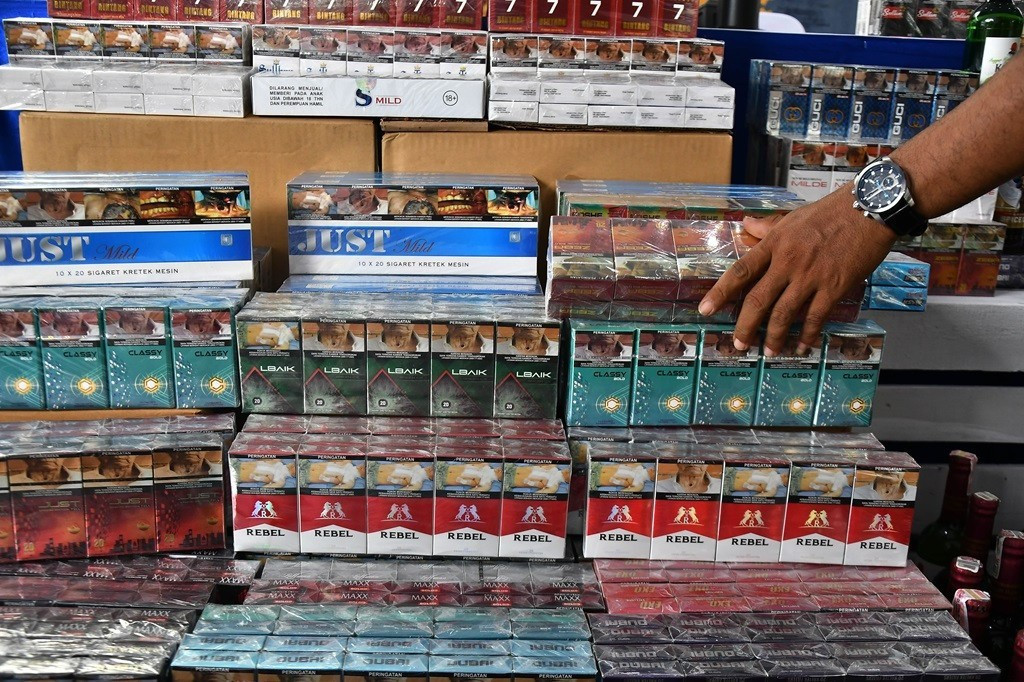 A Bekasi customs and excise official displays confiscated illegal cigarette packages set to be destroyed in Bekasi Regency, West Java on Dec. 6, 2023. (Antara/Fakhri Hermansyah)
I
ndonesia's illegal cigarette trade has long deprived the state of revenue and undermined formal producers. Recent allegations that people linked to a House of Representatives legislator sold counterfeit excise stamps, however, suggest that illicit trade may also involve those with access to formal institutions. The case raises questions about how illegal cigarettes keep circulating through counterfeit branding, informal distribution and alleged collusion, even as authorities tighten enforcement and regulation.
According to a Tempo investigation, counterfeit excise stamps have allegedly been linked to Adi Harnowo, a former expert staff member of House Commission XI Chairman Mukhamad Misbakhun. An East Java businessman reportedly bought two reams of stamps for Rp 60 million (US$3,336.86) each, roughly half the official price. He did so after Adi allegedly claimed he could provide excise stamp order (CK-1) documents and coordinate with Customs and Excise officials.
Two other staff members linked to Misbakhun were reportedly also involved, with a team allegedly preparing and shipping the stamps. In one transaction, more than Rp 600 million in cash was reportedly handed to one of the legislator's subordinates. A Malang entrepreneur also said that, at a 2024 meeting in a Jakarta hotel lobby arranged by one of Misbakhun's staff, the legislator told him he could deal with his subordinates if he wanted to buy stamps. The staff then set a minimum purchase of 100 reams a month, or Rp 6 billion at Rp 60 million per ream, and the entrepreneur backed out. Misbakhun did not respond to Tempo's interview requests before publication but has since denied involvement, as has Adi, who says he stopped working for the legislator in October 2024.
The allegations come as the Corruption Eradication Commission (KPK) investigates excise-stamp manipulation within a broader bribery and gratuity case involving Customs and Excise officials and PT Blueray Cargo owner John Field. Customs official Budiman Bayu Prasojo, arrested in the case, allegedly accepted bribes from cigarette entrepreneurs. These reportedly included Rp 100 million from HS cigarettes owner Muhammad Suryo for operating expenses, and Rp 30 million that investigators suspect Martinus Suparman and Johan Sugiharto paid to prevent the confiscation of their cigarettes. The KPK has also summoned Pamekasan tobacco trader Khairul Umam, known as Haji Her, who has said he did not know the suspects.
Such transactions explain why excise-stamp counterfeiting carries strict penalties. Law No. 39/2007 amended Law No. 11/1995 on excise. Under its Article 54, selling or delivering excise goods without retail packaging or excise stamps is punishable by one to five years in prison and/or a fine of two to 10 times the excise owed. Under Article 55, making, counterfeiting, buying, storing, using, or selling counterfeit or falsified stamps, or reusing used ones, carries one to eight years in prison and a fine of 10 to 20 times the excise value.
The market's scale helps explain why the problem persists. Tobacco products accounted for 96.2 percent of excise revenue in 2022–2023, and the industry supports millions of jobs. Repeated excise increases since 2014 have not eliminated demand. Instead, they have widened the price gap between legal and illegal cigarettes and pushed smaller producers outside the formal system. Enforcement campaigns such as "Gempur Rokok Ilegal" have often targeted retailers and distribution points, while production networks have proved harder to disrupt. The government has therefore paired enforcement with formalization. Its amnesty program encourages illegal producers to register, meet tax obligations, and enter the legal market.

Yet the persistence of illegal cigarettes points to deeper structural obstacles. Authorities confiscated 1.05 billion illegal cigarettes between January and August 2026, and the Directorate General of Customs and Excise destroyed 1.5 million plain cigarettes in Papua on Sep. 3. One survey estimated that illegal cigarettes made up 4.6 percent of national consumption, concentrated in East Java, West Kalimantan, and East Nusa Tenggara. Universitas Gadjah Mada researchers put illegal circulation at 13 percent of legal production, or roughly 40 billion cigarettes a year. The Finance Ministry estimates annual state losses of up to Rp 60 trillion, while Indodata puts them at Rp 97.81 trillion.