The Jakarta Post
Please Update your browser
Your browser is out of date, and may not be compatible with our website. A list of the most popular web browsers can be found below.
Just click on the icons to get to the download page.


Popular Reads
Top Results
No results found. Please check your search term and try again
Can't find what you're looking for?
View all search results
Popular Reads
Top Results
No results found. Please check your search term and try again
Can't find what you're looking for?
View all search resultsHigh shipping costs deepen the oil market crisis
Even as Asian crude imports head toward recovery, soaring logistics costs due to the Middle East war are cutting into refiners' margins, prompting them to seek solutions that would put pressure back on Gulf producers.
Change text size
Gift Premium Articles
to Anyone
Share the best of The Jakarta Post with friends, family, or colleagues. As a subscriber, you can gift 3 to 5 articles each month that anyone can read—no subscription needed!
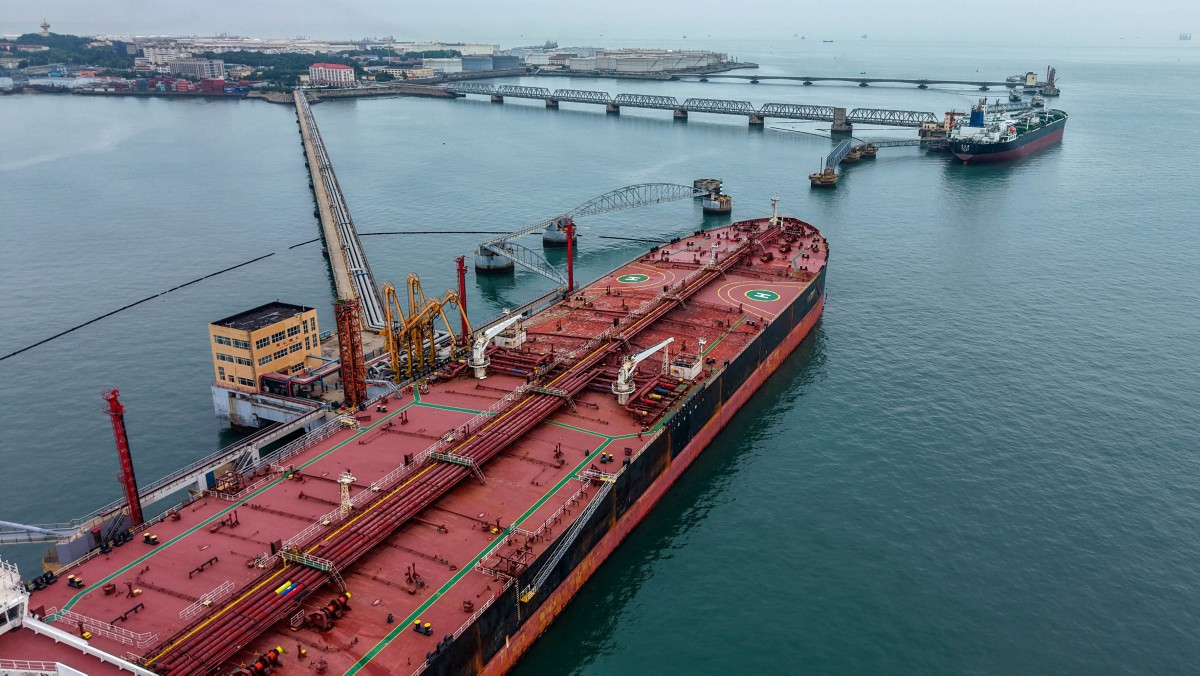 Tanker vessels unload imported crude oil on July 16, 2026, at Qingdao port in Shandong province, East China. (AFP/-)
S
hipping costs near record highs are crushing Asian refining margins even as global fuel markets run short of supply. To keep Asian refiners buying, Middle Eastern exporters may have to absorb more of those costs themselves, squeezing the revenue they desperately need after months of war.
In yet another sign of the extraordinary distortions rippling through global energy markets as the United States and Iran vie for control of the Strait of Hormuz, oil is increasingly flowing out of the Middle East, but actually getting it to customers has become so expensive that it threatens to undermine the recovery.
The energy crisis has shifted decidedly from a shortage of crude to a shortage of refined fuels. Global refining throughput is set to fall by 2.3 million barrels per day (bpd) this year to 81.7 million bpd, according to the International Energy Agency.
Many refineries have been damaged during the Middle East conflict, already in its eighth month, and Ukrainian strikes on Russian refineries have compounded the squeeze. Diesel has felt the impact most acutely, with prices hitting all-time highs last month.
Asia has borne much of the pain from the Hormuz disruption. The region has historically relied on the Middle East for around 60 percent of its oil supplies. After the war began, many Asian refiners were forced to reduce operating rates and scramble for alternative crude from as far away as the US and South America, at enormous cost.
Refiners elsewhere, particularly in the US and Europe, reaped the benefit as they ran at record levels while profit margins soared to record highs last month.

In theory, the recovery in Middle East oil exports in recent weeks should offer Asian refiners some much-needed relief. In practice, shipping economics are making that almost impossible.
Crude shipments from the Middle East have risen significantly over the past six weeks. Total Middle Eastern crude exports, including volumes shipped through routes bypassing Hormuz, rose to 15.4 million bpd in September, nearly 90 percent of prewar levels, according to Kpler data.
Much of that recovery came from transit through the strait itself. Flows through Hormuz climbed to 10.7 million bpd in September, around three-quarters of prewar levels, as Gulf producers stepped up tanker transits under US Navy supervision.
Asian crude imports are also recovering and are set to reach 23.5 million bpd in October, their highest level since February and slightly above the 2025 average. Middle Eastern barrels account for around 10 million bpd of that total, according to Kpler.
Yet the rebound in crude supplies has not translated into healthier profits for Asian refiners. In some cases, margins are hovering close to zero, according to traders.
The devil is in the delivery. Crude feedstock typically accounts for around 80 percent of a refinery's operating costs, while freight and insurance usually account for only around 3 to 7 percent of the delivered price of a barrel. Not anymore.
Repeated Iranian attacks on tankers transiting Hormuz have sent freight rates and insurance premiums soaring. The attacks have also forced traders and producers to construct elaborate logistical workarounds, using fleets of tankers to shuttle crude out of the Gulf and transfer cargoes between vessels.
This complex shuttle system requires so many tankers that it is limiting the vessels available globally, and in turn driving freight rates sky-high well beyond the Middle East.
For some refiners, shipping and insurance can now account for as much as 30 percent of the delivered cost of crude, according to ROI calculations.
Asia is particularly vulnerable. Not only does the region depend heavily on Middle Eastern oil, but replacing those barrels with crude from the Atlantic Basin involves much longer voyages and thus, much higher costs. Transporting a 2-million-barrel cargo from Nigeria to Singapore, for example, now costs around US$32 a barrel, roughly eight times its prewar level, according to LSEG data.
The impact on refining economics is striking. Gross Asian refining margins have averaged around US$40 a barrel so far in October, according to HiLo Analytics. But strip out average freight costs of roughly $33 a barrel, and refiners are left with a net margin of just over $7.
In other words, freight is consuming the equivalent of 82 percent of the gross margin available to Asian refiners. That compares with around 16 percent for refiners on the US Gulf Coast and in Northwest Europe, according to HiLo Analytics.
Asian refiners have several ways to respond to these shrinking margins, none of which is good news for Gulf producers.
They could cut overall processing rates while concentrating output on units producing the most profitable fuels, such as diesel. Some could also draw down domestic crude inventories rather than importing expensive replacement barrels. Both options would reduce their appetite for imported crude.
That puts the pressure back on Gulf producers, who are trying to maximize oil exports and rebuild revenue depleted during months of conflict.
Middle Eastern producers have already slashed selling prices to compensate buyers for soaring logistics costs, with some sellers reportedly offering discounts of as much as $30 a barrel. If the conflict drags on, that figure could climb as Gulf producers struggle to remain competitive.
Unfortunately for them, there is little sign that the freight squeeze is about to disappear. Iranian attacks on tankers crossing Hormuz have intensified over the past two weeks, reaching their highest weekly tally since the conflict began.
If the cost of moving each barrel keeps soaring while customers demand ever larger discounts, Gulf producers’ recovery may turn out to be a mirage.
---
The writer is a Reuters columnist. The views expressed are personal.