TheJakartaPost
Please Update your browser
Your browser is out of date, and may not be compatible with our website. A list of the most popular web browsers can be found below.
Just click on the icons to get to the download page.


Popular Reads
Top Results
No results found. Please check your search term and try again
Can't find what you're looking for?
View all search results
Popular Reads
Top Results
No results found. Please check your search term and try again
Can't find what you're looking for?
View all search resultsIndonesia’s trade surplus hits all-time high in April
High coal, crude palm oil prices boost exports.
Change text size
Gift Premium Articles
to Anyone
Share the best of The Jakarta Post with friends, family, or colleagues. As a subscriber, you can gift 3 to 5 articles each month that anyone can read—no subscription needed!
I
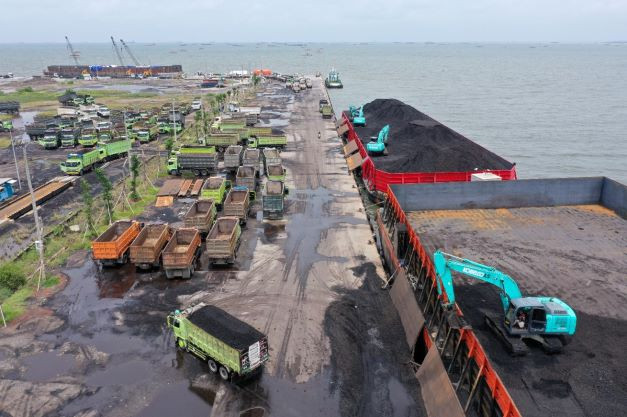
ndonesia’s trade surplus reached a record high in April, surpassing the previous peak in October 2021, as soaring global commodity prices boosted exports.
Statistics Indonesia (BPS) reported on Tuesday that the country had posted its 24th consecutive monthly surplus in April, which had more than tripled year-on-year (yoy) to US$7.56 billion. The figure was up 66 percent month-to-month (mtm).
“This is a new record, and it is [higher than the previous record set] in October 2021 at US$5.74 billion. Therefore, this surplus is the highest in history,” BPS head Margo Yuwono said during a press conference.
Indonesia's year-to-April trade surplus totaled $16.89 billion, the highest since 2017, Margo added.
Economists expect the country to gain on net from the global surge in commodity prices, which has been fueled by the Ukraine war and sanctions against Russia, as export gains from palm oil, coal and metal ore outweigh import increases, mainly of crude oil.
Read also: Ukraine war may bring windfall to Indonesia's trade balance
BPS data shows that coal prices reached $302 per ton, while CPO prices increased 56.09 percent yoy to $1682.7 per ton.
Indonesia's April exports increased 47.76 percent yoy to $27.32 billion. The mining industry had the strongest export growth, almost doubling yoy to $6.41 billion. Coal and iron ore led the rally in mining exports.
Oil and gas exports came third with a 48.39 percent yoy increase to $1.43 billion, followed by the manufacturing sector with 27.92 percent yoy growth to $19 billion. Agriculture came last with a 15.89 percent yoy increase to $0.39 billion.
BPS noted that crude palm oil (CPO) exports had fallen by $78.6 million from last month, following the government’s ban on the export of CPO and palm oil products on April 27.
The policy was introduced to bring domestic cooking oil prices down to Rp 14,000 per liter.
Read also: Cooking oil still too pricey to end ban
“Due to the export ban, overall exports will certainly be affected […]. [Its impact on] the trade balance and its significance will be reported next month,” Margo added.
Imports increased 21 percent yoy to $19 billion in April, led by raw materials imports, which posted a 25.51 percent yoy increase to $15.54 billion, as factories and business resumed operation in response to relaxed COVID-19 curbs.
Domestic manufacturing activity improved last month, as indicated by a 0.6 increase in the country’s purchasing managers’ index (PMI) to 51.9 in April.
Capital and consumer goods imports came next, with 15 percent yoy and 4 percent yoy increases to $2.52 billion and $1.7 billion, respectively. Oil and gas imports increased 88.49 percent yoy and 9.21 percent mtm to $3.81 billion, as recovering business activity raised domestic demand for energy.
Crude oil prices increased 65.45 percent yoy to $102.5 per barrel, while natural gas prices more than tripled yoy to $32.2 per million British thermal units (mmbtu).
However, in terms of monthly performance, all non-oil and gas imports saw a decline, led by capital goods falling 19.34 percent mtm, followed by raw materials and consumption falling 8.68 percent mtm and 6.40 percent mtm, respectively.
China remains Indonesia’s leading export destination, buying $5.49 billion worth of goods, accounting for 21.21 percent of all exports, followed by the United States and Japan with $2.46 billion and $2.24 billion, respectively.
In response to the April trade report, analysts from state-owned Bank Mandiri changed their Indonesian current account balance estimate from a deficit of 2.15 percent of GDP to a small surplus of 0.03 percent of GDP. In 2021, Indonesia experienced a surplus of 0.28 percent of GDP.
The analysts said the trade surplus would likely narrow in the coming months as imports accelerated amid a rebound in production.
“Yet the Russia-Ukraine war has prolonged the trend of commodity price hikes amid the ongoing global energy crisis. Hence, this will support exports and maintain the goods surplus for quite some time, since Indonesia’s top exports are mostly commodities, namely coal and CPO,” wrote the analysts.
Center of Economic and Law Studies (CELIOS) director Bhima Yudhistira said that rising fuel demand as business picked up in the coming months would widen the oil and gas trade deficit.
“There was a disturbance to export performance because the foreign exchange reserves were reduced due to the CPO export ban. So this needs to be watched out for in the future, namely changes that affect the trade balance, including the lockdown in China,” Bhima told The Jakarta Post.