TheJakartaPost
Please Update your browser
Your browser is out of date, and may not be compatible with our website. A list of the most popular web browsers can be found below.
Just click on the icons to get to the download page.


Popular Reads
Top Results
No results found. Please check your search term and try again
Can't find what you're looking for?
View all search results
Popular Reads
Top Results
No results found. Please check your search term and try again
Can't find what you're looking for?
View all search resultsPentagon orders more missiles for Middle East war
The extensive use of interceptor missiles by the United States, Israel and the Gulf states to counter Iranian retaliatory attacks has raised concerns about stockpile sizes.
Change text size
Gift Premium Articles
to Anyone
Share the best of The Jakarta Post with friends, family, or colleagues. As a subscriber, you can gift 3 to 5 articles each month that anyone can read—no subscription needed!
 People stand near a destroyed vehicle as smoke rises after a reported strike on Shahran fuel tanks, amid the US-Israeli conflict with Iran, in Tehran, Iran on March 8, 2026. (Reuters/Majid Asgaripour/WANA (West Asia News Agency)
T
he US Defense Department announced Wednesday agreements with defense contractors to put missile production "on a wartime footing" as the Mideast war leads to rapid use of munition stocks.
The extensive use of interceptor missiles by the United States, Israel and the Gulf states to counter Iranian retaliatory attacks has raised concerns about stockpile sizes.
In the first deal, Lockheed Martin and BAE Systems agreed to a fourfold increase in production of "seeker heads," a key component for the THAAD anti-missile system that has seen significant use in the Middle East.
The goal is to put the "industrial base on a wartime footing," the Pentagon said in a statement.
At the end of January, Lockheed Martin had already announced an acceleration of its THAAD production from around 100 a year to about 400 annually within a few years.
A second deal with Lockheed Martin will accelerate production of Precision Strike Missiles, or PrSM, tactical ballistic missiles used for the first time against Iran. They succeed the Army Tactical Missile System, or ATACMS.
Lockheed Martin confirmed the order, saying in a statement it builds on a previous $4.94 billion contract award from the US Army last year.
In a third deal, Honeywell Aerospace agreed to boost the production of "critical components for America's munitions stockpile," including navigation systems, the Pentagon said.
Honeywell said it included a multi-year investment of $500 million to upgrade its production capabilities to "rapidly increase the manufacturing of critical defense technologies."
It has committed to manufacturing more navigation systems as well as actuators for missile maneuverability and electronic warfare solutions, particularly for AMRAAM medium-range air-to-air missiles with radar guidance.
Lockheed Martin CEO Jim Taiclet also said the company was "working closely with the Department of War and the US Army to scale production to meet operational demand."
Trump in January signed an executive order directing officials to identify contractors deemed to be underperforming on government contracts while continuing to return profits to shareholders. His administration has also stepped up pressure on defense companies to prioritize production over shareholder payouts.
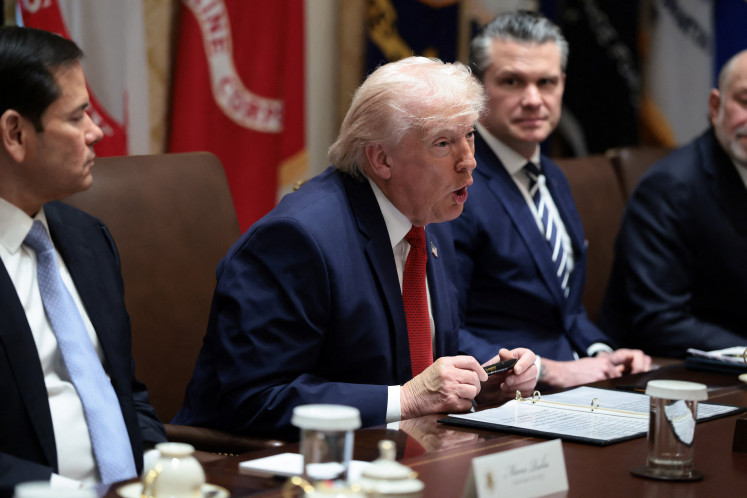
"We discussed production and production schedules," Trump said of the earlier meeting, which included executives from Lockheed Martin, BAE Systems, Boeing, Honeywell Aerospace, L3Harris Technologies and Northrop Grumman.
The United States has drawn down billions of dollars worth of weapons from its stockpiles since Russia invaded Ukraine in 2022, and during Israel's military operations in Gaza, including artillery systems, ammunition and anti-tank missiles.