TheJakartaPost
Please Update your browser
Your browser is out of date, and may not be compatible with our website. A list of the most popular web browsers can be found below.
Just click on the icons to get to the download page.


Popular Reads
Top Results
No results found. Please check your search term and try again
Can't find what you're looking for?
View all search results
Popular Reads
Top Results
No results found. Please check your search term and try again
Can't find what you're looking for?
View all search resultsAmerica's currency is the Global South's problem
Highly exposed to shocks originating in the US, Global South countries often have to align their monetary policies with America’s, in order to maintain currency stability and manage dollar-denominated debts.
Change text size
Gift Premium Articles
to Anyone
Share the best of The Jakarta Post with friends, family, or colleagues. As a subscriber, you can gift 3 to 5 articles each month that anyone can read—no subscription needed!
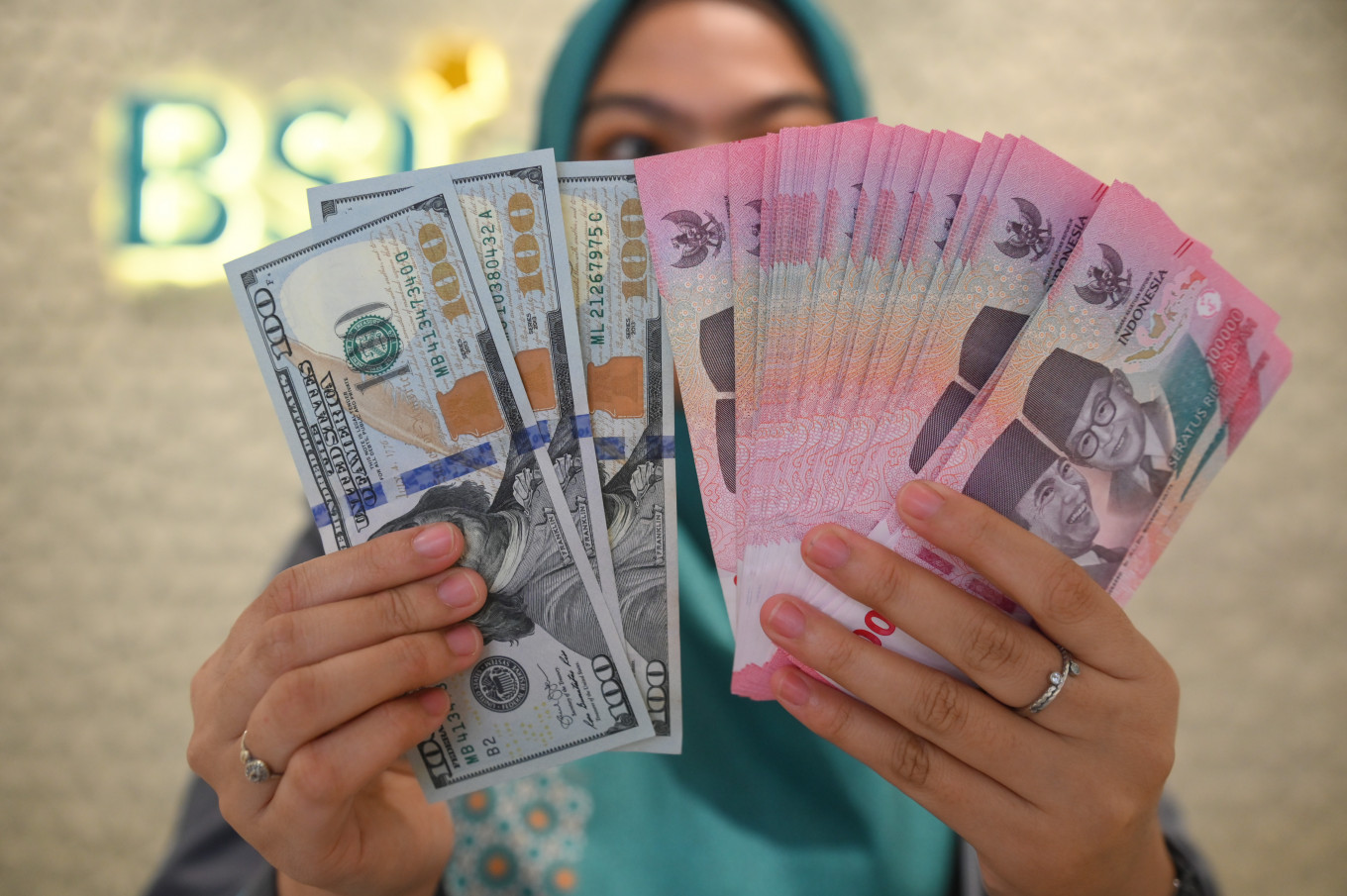 An employee displays Indonesian rupiah and US dollar banknotes on Jan. 21 at Bank Syariah Indonesia in South Tangerang, Banten. (Antara/Hafidz Mubarak A)
T
he United States dollar’s share in global foreign reserves peaked in 2001, and has been declining ever since. But while this trend is likely to continue, it is progressing very slowly, meaning that the greenback will retain its relative dominance, and the Global South will continue to suffer the consequences of US policy, for years to come.
There is currently no easy alternative to the dollar. For a currency to attain reserve status, it generally must be freely convertible, with a market-determined exchange rate. Moreover, the issuing country would typically possess a large economy, extensive international trade ties, deep and liquid financial markets and stable macroeconomic conditions and policies.
That reserve-issuing country should also be willing to run consistent fiscal and current-account deficits, in order to deliver sufficient liquidity, even as ever-expanding twin deficits risk undermining confidence in its economy (the so-called Triffin dilemma). On all these counts, the United States still performs exceptionally well.
But dependence on a dollar-based system carries significant risks for countries in the Global South. Highly exposed to shocks originating in the US, these countries often have to align their monetary policies with the US in order to maintain currency stability and manage dollar-denominated debts.
Moreover, when the dollar appreciates, dollar-denominated imports, such as oil, become more expensive, driving up inflation and complicating macroeconomic management. If sanctions are imposed on the dollar-denominated international payment system, developing economies’ ability to engage in cross-border trade and finance is impeded. Finally, the US dollar’s dominance hampers the growth of deep and liquid capital markets for developing economies’ currencies internationally.
Diversification away from the dollar is thus a strategic imperative for many countries. The question is how to go about it. Given that the dollar’s preeminence stems largely from its use in international transactions, one obvious action would be to promote the use of local currencies in international trade, such as through bilateral trade agreements.

Many developing and emerging economies are already doing this, especially when it comes to energy. India has begun rupee-based trade settlement with Iran, Russia and the United Arab Emirates. China and Saudi Arabia are moving toward similar arrangements. Argentina and Brazil have begun to discuss establishing a common currency, which could go a long way toward advancing the shift away from the dollar, though it would have to be expanded to include all major trading partners in the Global South.