TheJakartaPost
Please Update your browser
Your browser is out of date, and may not be compatible with our website. A list of the most popular web browsers can be found below.
Just click on the icons to get to the download page.


Popular Reads
Top Results
No results found. Please check your search term and try again
Can't find what you're looking for?
View all search results
Popular Reads
Top Results
No results found. Please check your search term and try again
Can't find what you're looking for?
View all search resultsThe 5Es of economic growth and impact on exchange rates (part 3)
Indonesia’s economic future hinges on the "Five Es", Energy, Exports, E-commerce, Equity and Employment, but structural vulnerabilities and capital flight threaten to stall its momentum. To escape the middle-income trap and unlock its massive demographic dividend, the nation must pivot from legacy economic models toward genuine sustainability, robust market governance, and job-ready education.
Change text size
Gift Premium Articles
to Anyone
Share the best of The Jakarta Post with friends, family, or colleagues. As a subscriber, you can gift 3 to 5 articles each month that anyone can read—no subscription needed!
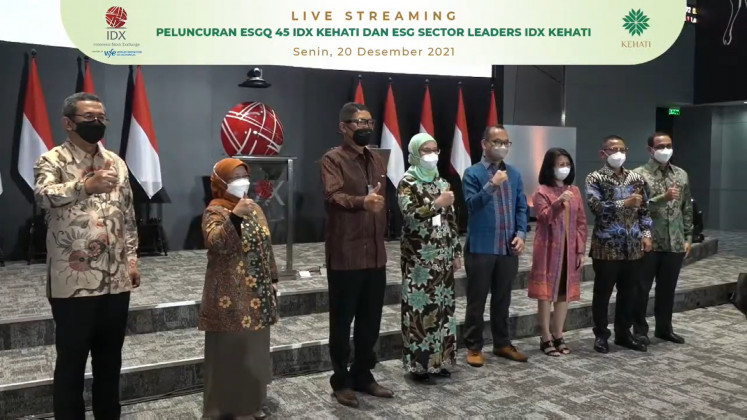
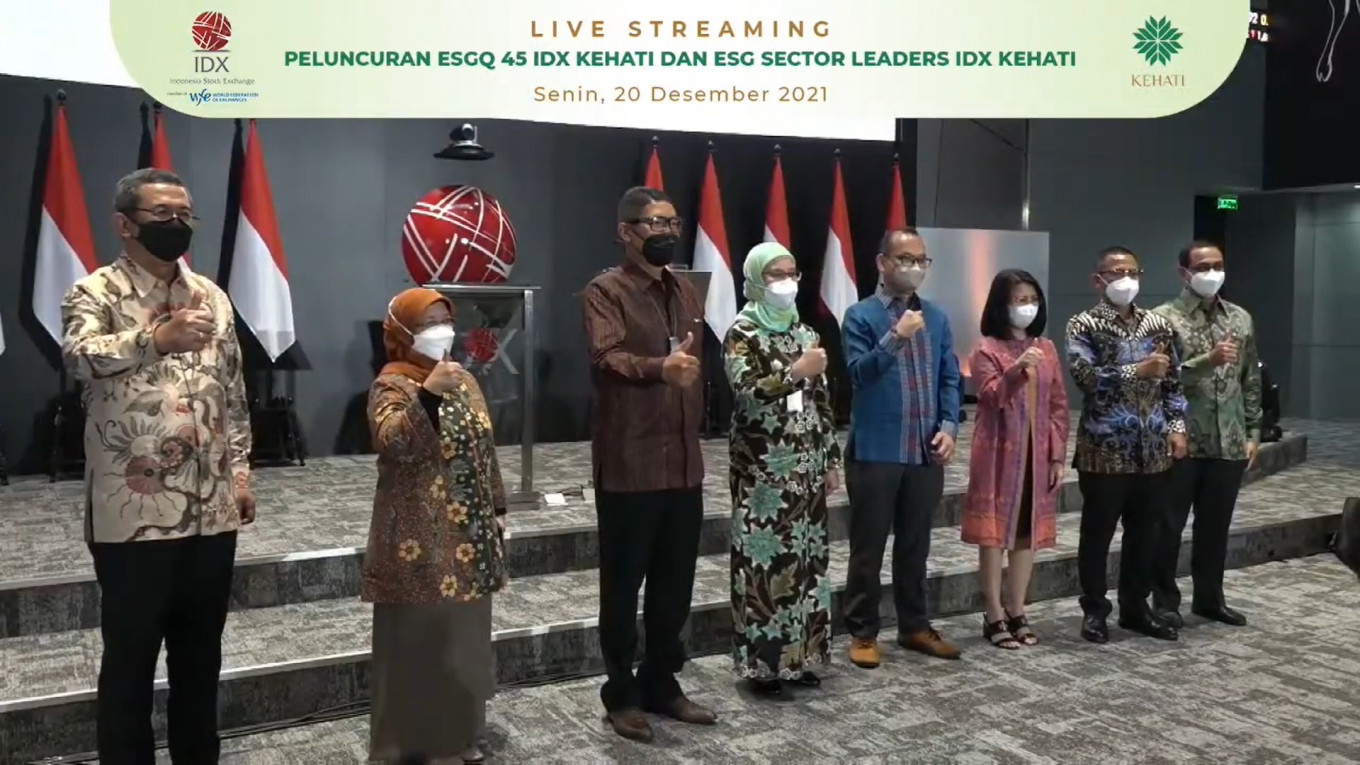 Indonesia Stock Exchange (IDX) president director Inarno Djajadi (third left) and Kehati Foundation executive director Riki Frindos (third right) during the launch of ESG Sector Leaders IDX KEHATI and ESG Quality 45 IDX KEHATI index at the IDX building on Dec. 20, 2021. (Indonesian Stock Exchange (IDX) YouTube channel/-)
E
ven if governments successfully align their policies toward energy security, export performance, and an equitable e-commerce ecosystem that protects local industries and small and medium-sized enterprises (SMEs), and that remains a significant caveat, they invariably face a steep uphill battle for financing.
Historically, traditional channels of finance have been rigidly dictated by borrowing tenure and structural complexity. Development institutions have traditionally bankrolled long-term infrastructure projects like railways, highways, airports, and power plants. Conversely, commercial banks have catered to short- to medium-term, straightforward operational needs, such as trade finance, capital expenditure imports, factory expansions and overdrafts to bridge cash-flow mismatches.
However, the demands of contemporary economies no longer fit neatly into these legacy silos. As the ongoing challenges in raising capital for sustainable projects, climate adaptation, and renewable energy demonstrate, there is an urgent need to tap into new pools of both domestic and foreign investment. This is precisely where equity markets are stepping into a pivotal role.
Neighboring Singapore offers a clear case study. Its equity and allied capital markets have rapidly evolved to provide a sophisticated suite of sustainable finance options. By 2025, nearly 11 percent of the market capitalization of the Straits Times Index (STI) was directly linked to the green economy. Listed property, utilities, industrial, and consumer staples firms have successfully secured financing for their sustainability initiatives.
Typically, these companies provide granular disclosures regarding their environmental, social and governance (ESG) progress, audited data, green certifications, and milestone reports on carbon footprint reduction. Once a credible cohort of sustainable companies gains traction on a major index, it naturally compels laggards to reform.
These trailing companies are forced to play catch-up in a global market where consumer choice and capital allocation are increasingly dictated by stringent metrics: the reduction of greenhouse gas (GHG) emissions across progressive Scope 1, 2, and 3 criteria; lowered consumption of raw materials, electricity, and water; the integration of circular, recycled solutions; and the strict avoidance of corporate scandals.

Progress on sustainable indices acts as a powerful magnet for foreign institutional investors (FIIs) that have hardcoded ESG criteria into their mandates. For instance, approximately US$800 million has been raised under the Monetary Authority of Singapore’s Financing Asia Transition Partnership (FAST-P) to target green infrastructure.